Definitions [3]
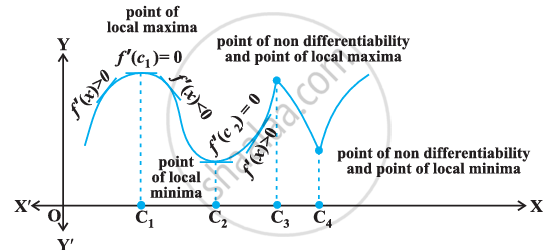
A point in the domain of a function is called a critical point if either the derivative is zero there or the derivative does not exist there. Critical points are checked while locating possible maxima or minima.
The points where a function changes from decreasing to increasing or from increasing to decreasing are called turning points.
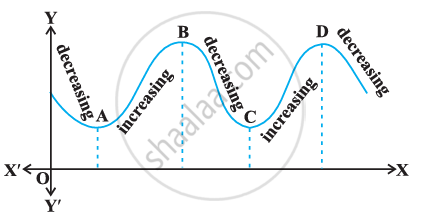
Let f be a function defined on an interval I.
Maximum value: f has a maximum value at c ∈ I if \[ \boxed{f(c) \geq f(x) \quad \text{for all } x \in I} \]
The value f(c) is called the maximum value and c is called a point of maximum.
Minimum value: f has a minimum value at c ∈ I if \[ \boxed{f(c) \leq f(x) \quad \text{for all } x \in I} \]
The value f(c) is called the minimum value and c is called a point of minimum.
Extreme value: A maximum or minimum value of f is called an extreme value.
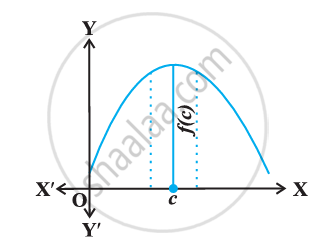
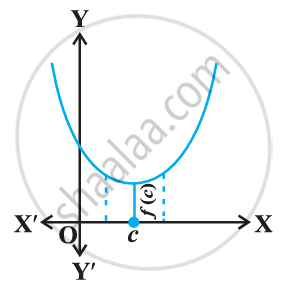
Maximum value Minimum value
Theorems and Laws [2]
Assume f'(c) = 0 and the second derivative exists at c:
-
Local Maximum: f''(c) < 0
-
Local Minimum: f''(c) > 0
-
Test Fails: f''(c) = 0. If this happens, you must go back and use the First Derivative Test to check if it is a maxima, minima, or point of inflection.
Let c be a critical point of a continuous function f:
-
Local Maximum: If f'(x) changes sign from positive to negative as x passes through c, then cc is a point of local maximum.
-
Local Minimum: If f'(x) changes sign from negative to positive then c is a point of local minimum.
-
Point of Inflection: f'(x) does not change sign as x passes through c (it is neither a maxima nor a minima).
Key Points
-
Maxima and minima are extreme values of a function.
-
Critical points occur where \(f'(x)=0\) or \(f'(x)\) is not defined.
-
If \(f'(x)\) changes from positive to negative, the function has a local maximum.
-
If \(f'(x)\) changes from negative to positive, the function has a local minimum.
-
If \(f''(c) < 0\), there is a local maximum at \(x=c\).
-
If \(f''(c) > 0\), there is a local minimum at \(x=c\).
-
For absolute extrema on \([a,b]\), compare values at critical points and endpoints.
-
Not every critical point gives a maximum or minimum.
-
The second derivative test is quick, but the first derivative test is often more reliable in detailed reasoning.
Concepts [5]
- Applications of Differentiation in Business and Economics
- Maxima and Minima
- Application/Practical Problems on Maxima and Minima
- Partial Derivatives
- Applications of Partial Derivatives
