Definitions [1]
Alcohols and phenols form esters by reaction with carboxylic acid, acid halides and acid anhydrides. This reaction is called esterification.
Key Points
Classification of Alcohols
Based on number of —OH groups
| Type | —OH Groups | Example |
|---|---|---|
| Monohydric | 1 | Ethanol (CH₃CH₂OH) |
| Dihydric | 2 | Ethylene glycol (CH₂OH–CH₂OH) |
| Trihydric | 3 | Glycerol |
| Polyhydric | More than 3 | Glucose |
Based on hybridisation of carbon bearing —OH (Monohydric only):
| Type | Description | Example |
|---|---|---|
| Primary (1°) | —OH on primary carbon | R–CH₂–OH |
| Secondary (2°) | —OH on secondary carbon | R–CH(OH)–R |
| Tertiary (3°) | —OH on tertiary carbon | R–C(OH)(R)–R |
| Allylic | —OH on sp³ carbon next to C=C | CH₂=CH–CH₂OH |
| Vinylic | —OH directly on sp² carbon of C=C | CH₂=CH–OH |
| Benzylic | —OH on sp³ carbon next to aromatic ring | C₆H₅–CH₂–OH |
Classification of Phenols
| Type | —OH Groups | Example |
|---|---|---|
| Monohydric | 1 | Phenol |
| Dihydric | 2 | Catechol (Benzene-1,2-diol) |
| Trihydric | 3 | Phloroglucinol (Benzene-1,3,5-triol) |
Classification of Ethers
| Type | Description | Example |
|---|---|---|
| Simple / Symmetrical | Same alkyl/aryl groups on both sides of O | CH₃–O–CH₃ (Dimethyl ether), C₆H₅–O–C₆H₅ (Diphenyl ether) |
| Mixed / Unsymmetrical | Different alkyl/aryl groups on both sides of O | CH₃–O–C₂H₅ (Ethyl methyl ether), C₂H₅–O–C₆H₅ (Ethyl phenyl ether) |
Classification of Alcohols
Based on number of —OH groups
| Type | —OH Groups | Example |
|---|---|---|
| Monohydric | 1 | Ethanol (CH₃CH₂OH) |
| Dihydric | 2 | Ethylene glycol (CH₂OH–CH₂OH) |
| Trihydric | 3 | Glycerol |
| Polyhydric | More than 3 | Glucose |
Based on hybridisation of carbon bearing —OH (Monohydric only):
| Type | Description | Example |
|---|---|---|
| Primary (1°) | —OH on primary carbon | R–CH₂–OH |
| Secondary (2°) | —OH on secondary carbon | R–CH(OH)–R |
| Tertiary (3°) | —OH on tertiary carbon | R–C(OH)(R)–R |
| Allylic | —OH on sp³ carbon next to C=C | CH₂=CH–CH₂OH |
| Vinylic | —OH directly on sp² carbon of C=C | CH₂=CH–OH |
| Benzylic | —OH on sp³ carbon next to aromatic ring | C₆H₅–CH₂–OH |
Classification of Phenols
| Type | —OH Groups | Example |
|---|---|---|
| Monohydric | 1 | Phenol |
| Dihydric | 2 | Catechol (Benzene-1,2-diol) |
| Trihydric | 3 | Phloroglucinol (Benzene-1,3,5-triol) |
Classification of Ethers
| Type | Description | Example |
|---|---|---|
| Simple / Symmetrical | Same alkyl/aryl groups on both sides of O | CH₃–O–CH₃ (Dimethyl ether), C₆H₅–O–C₆H₅ (Diphenyl ether) |
| Mixed / Unsymmetrical | Different alkyl/aryl groups on both sides of O | CH₃–O–C₂H₅ (Ethyl methyl ether), C₂H₅–O–C₆H₅ (Ethyl phenyl ether) |
- Alcohols: Compounds with one or more –OH groups attached directly to a carbon chain. General formula: C₂H₂ₙ₊₁OH.
- Phenols: Compounds where –OH group is directly bonded to an aromatic (benzene) ring.
- Ethers: Compounds with general formula R–O–R'. If R = R', it is a symmetrical ether; if R ≠ R', it is an unsymmetrical ether.
Types of Alcohols
| Type | Meaning | Position of —OH |
|---|---|---|
| Allylic Alcohol | —OH attached to sp³-hybridised carbon next to C=C double bond | Carbon next to C=C |
| Benzylic Alcohol | —OH attached to sp³-hybridised carbon next to aromatic ring | Benzylic carbon |
| Vinylic Alcohol | —OH attached directly to a vinylic carbon (CH₂=CH—) or aryl carbon | On C=C bond |
- Alcohol names are derived from alkanes by replacing ‘e’ with ‘ol’ (e.g., methane → methanol).
- In alcohols, the longest chain containing –OH is selected and numbered to give the lowest locant to the –OH group.
- Phenol is the simplest aromatic alcohol; substituted phenols use ortho (1,2), meta (1,3), and para (1,4) positions.
- Ethers are named as alkoxyalkanes in IUPAC; the smaller group becomes the alkoxy prefix.
- Common names: Alcohol → alkyl + alcohol, Ether → alkyl groups + ether
- Alcohols: O atom is sp³ hybridised; two bond pairs + two lone pairs; bent structure.
- Phenols: –OH directly on benzene ring; lone pair on O delocalised into ring → more acidic than alcohols.
- Ethers: O is sp³ hybridised. Two O–C sigma bonds + two lone pairs. Structure similar to water molecule. Bent/angular shape.
- Litmus Test — Aqueous alcohols are neutral to litmus, while aqueous phenols turn blue litmus red, confirming the acidic character of phenols.
- Reaction with Bases — Phenols react with NaOH to form water-soluble sodium phenoxide (regenerated on acidification with HCl) but do not react with NaHCO₃, since phenol is a weak acid.
- Esterification — Alcohols/phenols react with carboxylic acids (conc. H₂SO₄ catalyst), acid anhydrides (H⁺ catalyst), or acid chlorides (in pyridine) to form esters; Aspirin is the acetyl derivative of salicylic acid formed using acetic anhydride.
- Reactivity with Hydrogen Halides — Order of alcohol reactivity: 3° > 2° > 1°; order of HX reactivity: HI > HBr > HCl (HCl needs anhydrous ZnCl₂ catalyst).
- Oxidation of Alcohols — 1° alcohol → aldehyde (with PCC, best reagent) → further to carboxylic acid (with KMnO₄/K₂Cr₂O₇/HNO₃); 2° alcohol → ketone (with CrO₃); 3° alcohols resist oxidation and break C–C bonds only at high temperature.
Methanol (Wood Spirit):
-
Produced by catalytic hydrogenation of CO:
\[\ce{CO + 2H2 ->[ZnO/Cr2O3, 200-300atm, 573-673K] CH3OH}\]
-
Highly poisonous; used as a solvent in paints and varnishes.
Ethanol:
-
Produced by fermentation of sugar:
\[\ce{C12H22O11 + H2O ->[Invertase] \underset{Glucose}{C6H12O6} + \underset{Fructose}{C6H12O6}}\]
-
Used as a solvent and in the preparation of carbon compounds.
Differentiation between Methanol & Ethanol:
-
Iodoform test: Ethanol gives yellow ppt (CHI₃); methanol gives no reaction.
-
With salicylic acid + H₂SO₄: Methanol forms methyl salicylate (characteristic odour); ethanol gives no specific odour.
-
Williamson Synthesis (most important): R–O–Na + X–R' → R–O–R' + NaX. Primary alkyl halide is preferred (SN2 mechanism; 2° or 3° alkyl halide gives elimination).
-
Acid-catalysed dehydration of alcohols:
\[\ce{2R - OH ->[H2SO4, 413K] R - O - R + H2O}\]
(works best for symmetrical ethers)
-
From alcohols by catalytic dehydration:
\[\ce{2C2H5OH ->[Al2O3, 513-523K] C2H5 - O - C2H5 + H2O}\]
-
Alkoxy mercuration-demercuration: \[\begin{array}{cc}
\phantom{}\ce{CH3 - CH = CH2 + C2H5OH + Hg(OCOCF3)2 -> CH3 - CH - CH2 - HgOCOCF3 ->[NaBH4/OH^{-}] CH3 - CH - CH3}\\
\phantom{................................................................................}|\phantom{.....................................................................}|\phantom{.}\\
\phantom{............................................................................................}\ce{OC2H5}\phantom{...........................................................}\ce{O-C2H5}\phantom{.}
\end{array}\]
- Colourless liquids (except dimethyl ether and diethyl ether, which are gases).
- Polar due to bent structure (like a water molecule).
- Low boiling point due to the absence of H-bonding between ether molecules.
- Slightly soluble in water due to H-bonding with water; more soluble in organic solvents.
- Structure: O is sp³ hybridised; two sp³ orbitals form O–C sigma bonds; two sp³ orbitals have lone pairs.
- Methods of preparation of ethers: Acid-catalysed dehydration of alcohols (conc. H₂SO₄, 443 K); catalytic dehydration (Al₂O₃, 250°C); Williamson synthesis (alkyl halide + sodium alkoxide, Sₙ2); reaction of alkyl halides with dry Ag₂O.
- Preparation of Diethyl Ether (Simple Ether): From ethanol using conc. H₂SO₄ / H₃PO₄ at 413 K; or by Williamson's synthesis from C₂H₅ONa + BrCH₂CH₃ under heat.
- Reactions of Diethyl Ether: O₂ (long contact) → peroxide; dil. H₂SO₄ → 2 C₂H₅OH; PCl₅ → C₂H₅OH + C₂H₅Cl; hot HI → C₂H₅I + C₂H₅OH; excess HI → 2 C₂H₅I.
- Preparation of Anisole (Mixed Ether): CH₃Br + sodium phenoxide (C₆H₅ONa) → Methyl phenyl ether (Anisole) on heating.
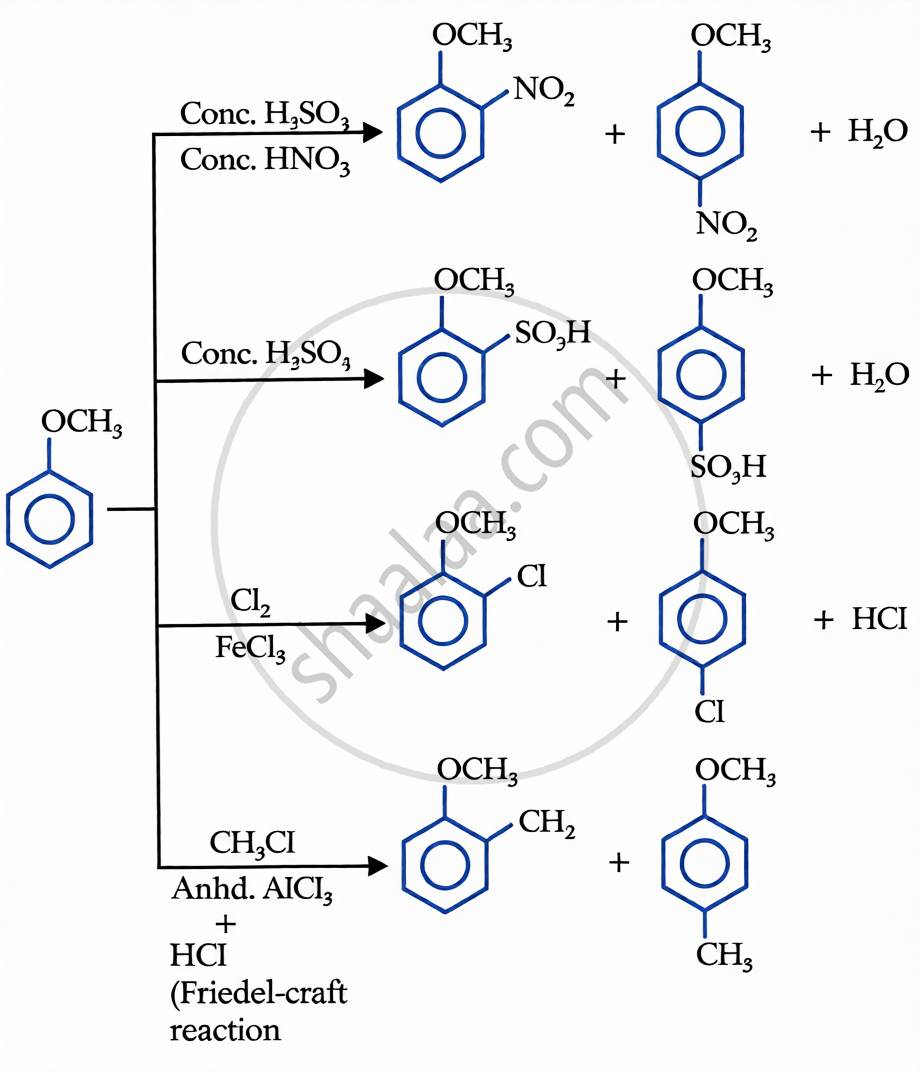
- Reactions of Anisole: HI (398 K) → phenol + CH₃I; Br₂/CH₃COOH → p-bromoanisole (major) + o-bromoanisole (minor); conc. HNO₃ + conc. H₂SO₄ → 4-nitroanisole (major) + 2-nitroanisole (minor); CH₃Cl/AlCl₃ → 4-methoxytoluene (major) + 2-methoxytoluene (minor); CH₃COCl/AlCl₃ → 4-methoxyacetophenone (major) + 2-methoxyacetophenone (minor).
- Ethers are generally very unreactive (no H-bonding between ether molecules).
- When excess HX is added → C–O bond cleaves → alkyl halides.
- Reactivity of HX: HI > HBr > HCl
- If 1° or 2° alkyl groups: Smaller alkyl group forms alkyl iodide. (e.g., C₂H₅–O–CH₃ + HI → C₂H₅OH + CH₃I)
- If one alkyl group is 3°: Forms tertiary alkyl halide (SN1 pathway).
Reaction with conc. HI:
- With excess HI: Both groups convert to iodo compounds
- e.g., \[\ce{C2H5OC2H5 + HI ->[Cold] C2H5I + C2H5OH}\]
Substitution Reactions in Aromatic Ether: The alkoxу group in ether activates the aromatic ring at ortho and para positions for electrophilic substitution. Common electrophilic substitution reactions are halogenation, Friedel-Crafts reaction, etc.
Concepts [19]
- Classification of Alcohols, Phenols and Ethers
- Classification of Alcohols, Phenols and Ethers
- Concept of Alcohols, Phenols and Ethers
- Nomenclature of Alcohols, Phenols and Ethers
- Structures of Functional Groups of Alcohols, Phenols and Ethers
- Methods of Preparation of Alcohols
- Methods of Preparation of Phenols
- Chemical Properties of Alcohols and Phenols
- Chemical Reactions of Alcohols and Phenols
- Reactions Involving Cleavage of O-H Bond
- Reactions Involving Cleavage of Carbon–Oxygen (C–O) Bond in Alcohols
- Chemical Properties of Phenol
- Commercially Importance Alcohols
- Uses of Phenols
- Preparation of Ethers
- Physical Properties of Ethers
- Chemical Reaction of Ethers - Cleavege of C-O Bonds
- Chemical Reaction of Ethers - Electrophilic Substitution
- Uses of Ethers
