Definitions [3]
Let A = [aij] be a square matrix of order n. Then, the minor Mij of aij in A is the determinant obtained by deleting the ith row and the jth column in which element aij lies. It is denoted by Mij of A.
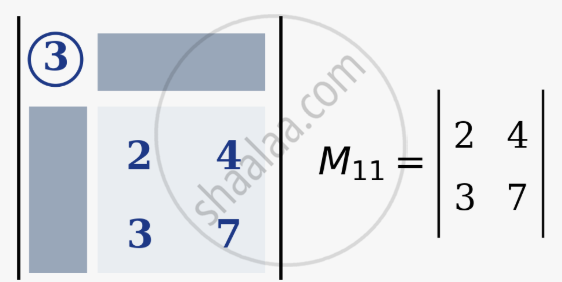
Let A = [aij] be a square matrix of order n. Then, the cofactor Cij (or Aij) of aij in A is (−1)i+j times Mij, where Mij is the minor of aij in A.
∴ Cij = (−1)i+j Mij
Let \[A = [a_{ij}]\] be an \[m \times n\] matrix and \[B = [b_{jk}]\] be an \[n \times p\] matrix.
Then the product C = AB is an \[m \times p\] matrix \[C = [c_{ik}]\], where each entry \[c_{ik}\] is given by:
Key Points
-
Minor \[M_{ij}\]: determinant of the matrix obtained by deleting row i and column j.
-
Cofactor \[C_{ij}\]: \[C_{ij} = (-1)^{i+j}M_{ij}\].
-
Determinant expansion along row i: \[|A| = \sum_{j=1}^{n} a_{ij}C_{ij}\].
-
Determinant expansion along column j: \[|A| = \sum_{i=1}^{n} a_{ij}C_{ij}\].
-
Determinant value is the same for any choice of row or column for expansion.
-
Mixed row/column property: \[\sum_{j=1}^{n} a_{ij}C_{kj} = 0\] for \[i \neq k\].
-
Matrix multiplication is row-by-column, not term-wise.
-
Product AB exists only if columns of A = rows of B.
-
If A is \[m \times n\] and B is \[n \times p\], then AB is \[m \times p\].
-
In general, \[AB \neq BA\], and sometimes one product may not even be defined.
-
Matrix multiplication is associative and distributive over addition.
-
Identity matrix acts as a multiplicative identity: AI = IA = A.
-
Zero matrix absorbs multiplication: AO = OA = O.
