Commerce (English Medium)
Science (English Medium)
Arts (English Medium)
Academic Year: 2024-2025
Date & Time: 1st April 2025, 10:30 am
Duration: 3h
Advertisements
General Instructions:
Read the following instructions carefully and follow them:
- This question paper contains 34 questions. All questions are compulsory.
- The question paper is divided into five Sections – A, B, C, D, and E.
- Section A – Question numbers 1 to 21 are Multiple Choice Questions. Each question carries 1 mark.
- Section B – Question numbers 22 to 27 are Short Answer type Questions. Each question carries 3 marks. Write the answer to each question in 60 to 80 words.
- Section C – Question numbers 28 to 30 are Long Answer (LA) type Questions. Each question carries 8 marks. Write the answer to each question in 300 to 350 words.
- Section D – Question numbers 31 to 33 are Source-based Questions having three sub-questions. Each question carries 4 marks.
- Section E – Question number 34 is a Map-based Question that includes the identification and location of significant test items. This question carries 5 marks. Attach the map with the answer-book.
- There is no overall choice. However, an internal choice has been provided in Sections B and C of the question paper.
A candidate has to write the answer to only one of the alternatives in such questions. - In addition to this, NOTE that a separate question has been provided for Visually Impaired Candidates in lieu of questions having visual inputs, a map, etc. Such questions are to be attempted by Visually Impaired Candidates only.
Assertion (A): Harappa was a well-planned city.
Reason (R): It had a well-planned drainage system.
Both (A) and (R) are correct, and (R) is the correct reasoning of (A).
Both (A) and (R) are correct, but (R) is not the correct reasoning of (A).
(A) is correct, but (R) is not correct.
(A) is not correct, but (R) is correct.
Chapter:
Which one of the following is a correct statement regarding the codes of social behaviour as laid down in the Dharamasutras and the Dharmashastras during the period of the Mahabharata?
These norms were to be followed by the Brahmins only.
These norms were being followed universally.
These norms were not followed universally.
Only the rulers followed these norms.
Chapter:
Which one of the following dynasties did Queen Prabhavati belong to?
Kanvas
Shakas
Vakataka
Maurya
Chapter:
Which one of the following was a distinctive feature of Harappan architecture?
Use of Wood
Use of Iron
Use of Bricks
Use of Marble
Chapter:
Identify the ruler from Indian history with the following information:
|
Jehanara Begum
Shahjehan Begum
Gulbadan Begum
Rukhsaar Begum
Chapter:
The given sculpture from the fifth-century Devgarh temple depicts which of the following deities?
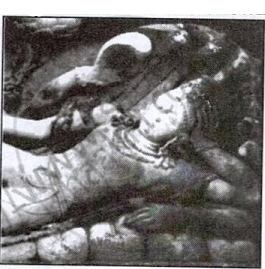
Indra
Shiva
Rudra
Vishnu
Chapter:
Match Column-I with Column-II and choose the correct option:
| Column-I (Sculpture of Sanchi) |
Column-II (Symbolic Importance) |
| a. Empty seat | i. Indicator of Mahaparinibbana |
| b. Gajlakshmi | ii. Indicator of good fortune |
| c. Wheel | iii. Indicator of auspicious |
| d. Shalbhanjika | iv. Indicator of the first sermon of Buddha |
a − i, b − ii, c − iv, d − iii
a − ii, b − iii, c − i, d − iv
a − ii, b − i, c − iv, d − iii
a − iv, b − i, c − iii, d − ii
Chapter:
Match Column-I with Column-II and choose the correct option:
| Column-I (Temple) |
Column-II (Location) |
| a. Brihadeswara temple | 1. Vijayanagara |
| b. Chennakeshava temple | 2. Tamil Nadu |
| c. Hazara Ram temple | 3. Belur |
| d. Chidambaram temple | 4. Tanjavur |
a − 1, b − 3, c − 4, d − 2
a − 2, b − 4, c − 3, d − 1
a − 4, b − 3, c − 1, d − 2
a − 1, b − 3, c − 2, d − 4
Chapter:
Arrange the following in chronological order and choose the correct option:
- Battle of Talikota
- Establishment of Nagalapuram
- Formation of Kamalapuram Tank
- Emergence of the Sultanate of Golconda
I, II, III, IV
II, III, IV, I
III, II, IV, I
IV, I, III, II
Chapter:
Identify the ruler of India from the sixteenth century with the following information and choose the correct option:
|
Sultan Ghias-ud-din Khalji
Shah-Jehan
Akbar
Muhammad Bin Tughlaq
Chapter:
Who among the following included the composition of Guru Tegh Bahadur ji in the Guru Granth Sahib?
Guru Hargobind Sahibji
Guru Gobind Singhji
Guru Arjan Devji
Guru Harkrishan Sahibji
Chapter:
Which of the following statements is true regarding the land revenue system of the Mughals?
The revenue collectors collected tax of land in cash only.
The cultivated lands were taxed without any measurement.
Revenue from the land was the economic mainstay of the empire.
The tax collectors used to collect taxes with the help of Sahukars.
Chapter:
Identify the correct statement from the following regarding the role of women in the agrarian society of the Mughal State.
Only artisanal work was done by women.
Women worked in the fields with men.
Remarriage was not allowed for divorced women.
Women were totally independent.
Chapter:
Advertisements
Which one of the following statements is correct regarding the Virashaiva or Lingayat tradition?
They emphasize Brahman as the supreme entity.
They do not bury their dead persons.
They believe that on death, they will be united with Shiva.
They are the followers of Vishnu.
Chapter:
How was the Constituent Assembly influenced by public opinion? Choose the correct option:
- People aired their views outside the Parliament House.
- People gave their reactions through the press.
- The members of the Constituent Assembly used to discuss with the public.
- The public expressed their views in the Constituent Assembly.
I, III & IV
II, III & IV
I, IV & II
I, II & III
Chapter:
Which of the following statements best describes the effect of the Permanent Settlement on Zamindars?
They become landless labourers.
They all were replaced by Jotedars.
They sold their land to the British.
They gained significant control over land.
Chapter:
The Revolt of 1857 marked the end of the ______ dynasty in India.
Maratha
Rajput
Scindhia
Mughal
Chapter:
Find the odd one out regarding the revolt of 1857 from the following:
Arrah : Kunwar Singh
Barout : Shah Mal
Singhbhum : Gonu
Hyderabad : Maulavi Ahmadullah Shah
Chapter:
Identify the person from the given information:
|
Gobind Ballabh Pant
R.V. Dhulekar
Vallabhbhai Patel
Pandit Nehru
Chapter:
On whose of the following advice Gandhiji spent a year in travelling around British India for getting to know the land and its people before entering into politics?
Bal Gangadhar Tilak
Gopal Krishna Gokhale
Lala Lajpat Rai
Bipin Chandra Pal
Chapter:
Why did Gandhi call for a nationwide campaign against the ‘Rowlatt Act’? Choose the appropriate option from the following:
The British Government closed all the schools and colleges.
The First World War came to an end.
British Govt. permitted detention without trial.
People expected independence from the British.
Chapter:
Why were the seals and sealings used by the Harappans to facilitate long-distance communication? Explain with examples.
Chapter:
“There were different views of archaeologists on the administration of Harappa.” Explain the statement with examples.
Chapter:
Explain any three sources to know about the Gupta Empire.
Chapter:
Analyse the role of Krishnadeva Raya in the Vijayanagara empire.
Chapter:
Analyse the importance of Mahanavami Dibba in the Vijayanagara empire.
Chapter:
Advertisements
Describe the role of Zamindars in the Mughal era.
Chapter:
Analyse the impact of the policy of annexation imposed by the British during 1850s.
Chapter:
“K. Santhanam was in favour of giving greater powers to the provinces in the Constituent Assembly.” Examine the statement.
Chapter:
‘Francois Bernier contrasted what he saw in India with the situation in Europe.’ Explain the statement with examples.
Chapter:
‘Ibn-Battuta has written extensively about his experience in India.’ Explain the statement with examples.
Chapter:
Examine the nature and characteristics of the land grants in ancient Indian society.
Chapter:
Examine the various strategies used to enhance agricultural output from the sixth BCE onwards.
Chapter:
Examine various aspects of administration and other activities of the East India Company as contained in the fifth report.
Chapter:
Examine the causes of resistance and failure of zamindars to make payment of land revenue to the East India Company in Bengal during the eighteenth century.
Chapter:
Read the following source carefully and answer the questions that follow:
|
Amir Khusrau and the Qaul Amir Khusrau (1253-1325), the great poet, musician, and disciple of Shaikh Nizamuddin Auliya, gave a unique form to the Chishti ‘sama’ by introducing the qaul (Arabic word meaning “saying”), a hymn sung at the opening or closing of qawwali. This was followed by Sufi poetry in Persian, Hindavi, or Urdu, and sometimes using words from all of these languages. Qawwals (those who sing these songs) at the shrine of Shaikh Nizamuddin Auliya always start their recital with the qaul. |
- What unique form did Amir Khusrau introduce to the Chishti ‘sama’? (1)
- How did the Chishti Sufi traditions shape Amir Khusrau’s understanding of spirituality? (1)
- Analyse the significance of Sufism in the qawwali performances. (2)
Chapter:
Read the following source carefully and answer the questions that follow:
|
Why the Salt Satyagraha? Why was salt the symbol of protest? This is what Mahatma Gandhi wrote: The volume of information being gained daily shows how wickedly the salt tax has been designed. In order to prevent the use of salt that has not paid the tax, which is at times even fourteen times its value, the Government destroys the salt it cannot sell profitably. Thus, it taxes the nation’s vital necessity; it prevents the public from manufacturing it and destroys what nature manufactures without effort. No adjective is strong enough for characterising this wicked dog-in-the-manger policy. From various sources, I hear tales of such wanton destruction of the nation’s property in all parts of India. Maunds, if not tons of salt, are said to be destroyed on the Konkan coast. The same tale comes from Dandi. Wherever there is a likelihood of natural salt being taken away by the people living in the neighbourhood of such areas for their personal use, salt officers are posted for the sole purpose of carrying on destruction. Thus, valuable national property is destroyed at national expense and salt taken out of the mouths of the people. The salt monopoly is thus a fourfold curse. It deprives the people of a valuable, easy village industry, involves wanton destruction of property that nature produces in abundance, the destruction itself means more national expenditure, and fourthly, to crown this folly, an unheard of tax of more than 1,000 per cent is exacted from a starving people. This tax has remained so long because of the apathy of the general public. Now that it is sufficiently roused, the tax has to go. How soon it will be abolished depends upon the strength of the people. The Collected Works of Mahatma Gandhi (CWMG), Vol.49 |
- Why was the salt law disliked by the masses? (1)
- Why were salt officers appointed by the British Government? (1)
- Why did Lord Irwin fail to understand the significance of the Salt March? (2)
Chapter:
Read the given source carefully and answer the questions that follow:
|
Verses from the Upanishads Here are two verses from the Chhandogya Upanishad, a text composed in Sanskrit c. sixth century ВСЕ: The Nature of the Self This self of mine within the heart is smaller than paddy or barley or mustard or millet or the kernel of a seed of millet. This self of mine within the heart is greater than the earth, greater than the intermediate space, greater than heaven, greater than these worlds. The True Sacrifice This one (the wind) that blows, this is surely a sacrifice... While moving it sanctifies all this; therefore, it is indeed a sacrifice. |
- Mention the main theme of the verse. (1)
- Mention the relationship between the self and the wind in the context of these verses. (1)
- How does this source reflect the philosophical ideas of the Upanishads? (2)
Chapter:
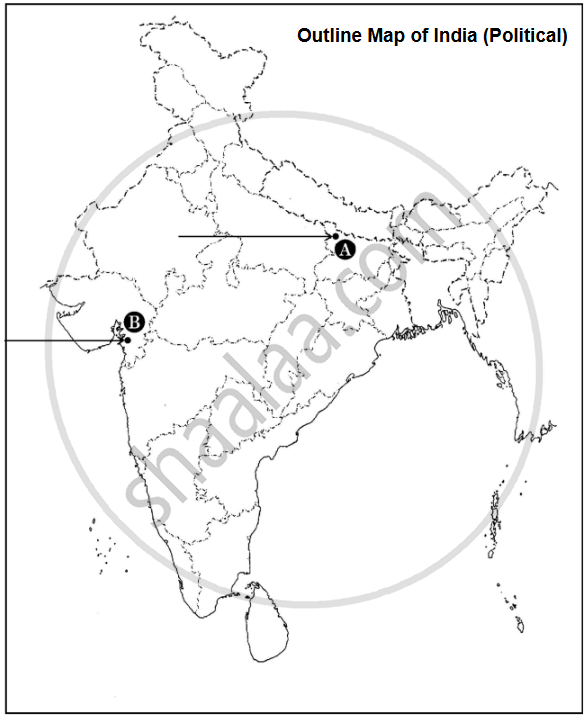
1. On the given political outline map of India, locate and label the following places with appropriate symbols:
- Rakhigarhi – a mature Harappan site
- Ajanta – a Buddhist site
-
- Ajmer – a territory under the Mughals
OR - Agra – a territory under Mughals
- Ajmer – a territory under the Mughals
2. On the same map, two places have been marked as A and B as the centres of the Indian National movement. Identify them and write their names on the lines drawn near them.
Chapter:
Other Solutions
Submit Question Paper
Help us maintain new question papers on Shaalaa.com, so we can continue to help studentsonly jpg, png and pdf files
CBSE previous year question papers Class 12 History with solutions 2024 - 2025
Previous year Question paper for CBSE Class 12 History-2025 is solved by experts. Solved question papers gives you the chance to check yourself after your mock test.
By referring the question paper Solutions for History, you can scale your preparation level and work on your weak areas. It will also help the candidates in developing the time-management skills. Practice makes perfect, and there is no better way to practice than to attempt previous year question paper solutions of CBSE Class 12.
How CBSE Class 12 Question Paper solutions Help Students ?
• Question paper solutions for History will helps students to prepare for exam.
• Question paper with answer will boost students confidence in exam time and also give you an idea About the important questions and topics to be prepared for the board exam.
• For finding solution of question papers no need to refer so multiple sources like textbook or guides.
