Advertisements
Advertisements
Question
Advertisements
Solution
We have,
\[x\frac{dy}{dx} + 2y = x \cos x\]
\[ \Rightarrow \frac{dy}{dx} + \frac{2}{x}y = \cos x\]
\[\text{ Comparing with }\frac{dy}{dx} + Py = Q, \text{ we get }\]
\[P = \frac{2}{x}\]
\[Q = \cos x\]
Now,
\[I.F. = e^{\int\frac{2}{x}dx} = e^{2\log \left| x \right|} = x^2 \]
Solution is given by,
\[y \times I . F . = \int\cos x \times I . F . dx + C\]
\[ \Rightarrow y x^2 = \int x^2 \cos x \text{ dx } + C\]
\[ \Rightarrow x^2 y = I + C . . . . . . . . . \left( 1 \right)\]
Where,
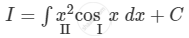
\[ \Rightarrow I = x^2 \int\cos x dx - \int\left[ \frac{d}{dx}\left( x^2 \right)\int\cos x \text{ dx } \right]dx\]
\[ \Rightarrow I = x^2 \sin x - 2\int x \sin x \text{ dx }\]

\[ \Rightarrow I = x^2 \sin x - 2x\int\sin x \text{ dx } + 2\int\left[ \frac{d}{dx}\left( x \right)\int\sin x dx \right]dx\]
\[ \Rightarrow I = x^2 \sin x + 2x \cos x - 2\int\cos \text{ x } dx\]
\[ \Rightarrow I = x^2 \sin x + 2x \cos x - 2\sin x\]
\[\text{ Therefore }\left( 1 \right)\text{ becomes }\]
\[ \therefore x^2 y = x^2 \sin x + 2x \cos x - 2\sin x + C\]
APPEARS IN
RELATED QUESTIONS
Find the the differential equation for all the straight lines, which are at a unit distance from the origin.
For the differential equation, find the general solution:
`dy/dx + y/x = x^2`
For the differential equation, find the general solution:
`x log x dy/dx + y= 2/x log x`
For the differential equation, find the general solution:
(1 + x2) dy + 2xy dx = cot x dx (x ≠ 0)
For the differential equation, find the general solution:
`x dy/dx + y - x + xy cot x = 0(x != 0)`
For the differential equation given, find a particular solution satisfying the given condition:
`dy/dx + 2y tan x = sin x; y = 0 " when x " = pi/3`
Solve the differential equation `(tan^(-1) x- y) dx = (1 + x^2) dy`
(x + tan y) dy = sin 2y dx
\[\frac{dy}{dx}\] + y cos x = sin x cos x
Find the general solution of the differential equation \[\frac{dy}{dx} - y = \cos x\]
Solve the following differential equation:- \[\left( \cot^{- 1} y + x \right) dy = \left( 1 + y^2 \right) dx\]
Solve the following differential equation: \[\left( \cot^{- 1} y + x \right) dy = \left( 1 + y^2 \right) dx\] .
Solve the differential equation \[\frac{dy}{dx}\] + y cot x = 2 cos x, given that y = 0 when x = \[\frac{\pi}{2}\] .
If f(x) = x + 1, find `"d"/"dx"("fof") ("x")`
Solve the differential equation: `(1 + x^2) dy/dx + 2xy - 4x^2 = 0,` subject to the initial condition y(0) = 0.
Solve the following differential equation:
`dy/dx + y/x = x^3 - 3`
Solve the following differential equation:
`"x" "dy"/"dx" + "2y" = "x"^2 * log "x"`
Solve the following differential equation:
`("x + y") "dy"/"dx" = 1`
Solve the following differential equation:
`("x + a")"dy"/"dx" - 3"y" = ("x + a")^5`
Solve the following differential equation:
y dx + (x - y2) dy = 0
Solve the following differential equation:
`(1 + "x"^2) "dy"/"dx" + "y" = "e"^(tan^-1 "x")`
The curve passes through the point (0, 2). The sum of the coordinates of any point on the curve exceeds the slope of the tangent to the curve at any point by 5. Find the equation of the curve.
If the slope of the tangent to the curve at each of its point is equal to the sum of abscissa and the product of the abscissa and ordinate of the point. Also, the curve passes through the point (0, 1). Find the equation of the curve.
Find the general solution of the equation `("d"y)/("d"x) - y` = 2x.
Solution: The equation `("d"y)/("d"x) - y` = 2x
is of the form `("d"y)/("d"x) + "P"y` = Q
where P = `square` and Q = `square`
∴ I.F. = `"e"^(int-"d"x)` = e–x
∴ the solution of the linear differential equation is
ye–x = `int 2x*"e"^-x "d"x + "c"`
∴ ye–x = `2int x*"e"^-x "d"x + "c"`
= `2{x int"e"^-x "d"x - int square "d"x* "d"/("d"x) square"d"x} + "c"`
= `2{x ("e"^-x)/(-1) - int ("e"^-x)/(-1)*1"d"x} + "c"`
∴ ye–x = `-2x*"e"^-x + 2int"e"^-x "d"x + "c"`
∴ e–xy = `-2x*"e"^-x+ 2 square + "c"`
∴ `y + square + square` = cex is the required general solution of the given differential equation
The integrating factor of the differential equation sin y `("dy"/"dx")` = cos y(1 - x cos y) is ______.
The integrating factor of the differential equation (1 + x2)dt = (tan-1 x - t)dx is ______.
Integrating factor of the differential equation `(1 - x^2) ("d"y)/("d"x) - xy` = 1 is ______.
The equation x2 + yx2 + x + y = 0 represents
If y = y(x) is the solution of the differential equation, `(dy)/(dx) + 2ytanx = sinx, y(π/3)` = 0, then the maximum value of the function y (x) over R is equal to ______.
Let y = y(x) be a solution curve of the differential equation (y + 1)tan2xdx + tanxdy + ydx = 0, `x∈(0, π/2)`. If `lim_(x→0^+)` xy(x) = 1, then the value of `y(π/2)` is ______.
Let y = f(x) be a real-valued differentiable function on R (the set of all real numbers) such that f(1) = 1. If f(x) satisfies xf'(x) = x2 + f(x) – 2, then the area bounded by f(x) with x-axis between ordinates x = 0 and x = 3 is equal to ______.
Let y = y(x) be the solution curve of the differential equation `(dy)/(dx) + ((2x^2 + 11x + 13)/(x^3 + 6x^2 + 11x + 6)) y = ((x + 3))/(x + 1), x > - 1`, which passes through the point (0, 1). Then y(1) is equal to ______.
If sin x is the integrating factor (IF) of the linear differential equation `dy/dx + Py` = Q then P is ______.
If sec x + tan x is the integrating factor of `dy/dx + Py` = Q, then value of P is ______.
The slope of tangent at any point on the curve is 3. lf the curve passes through (1, 1), then the equation of curve is ______.
Solve:
`xsinx dy/dx + (xcosx + sinx)y` = sin x
The slope of the tangent to the curve x = sin θ and y = cos 2θ at θ = `π/6` is ______.
