Advertisements
Advertisements
Question
Write the equation of the line :
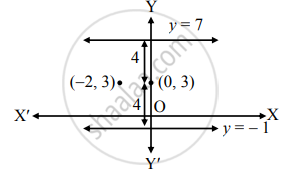
parallel to the X-axis and at a distance of 4 unit form the point (−2, 3)
Advertisements
Solution
Equation of a line parallel to the X-axis is of the form y = k (k > 0 or k < 0).
Since the line is at a distance of 4 units from the point (− 2, 3),
k = 4 + 3 = 7 or k = 3 – 4 = – 1
∴ The equation of the required line is y = 7 or y = – 1.
APPEARS IN
RELATED QUESTIONS
Write the equation of the line :
parallel to the Y−axis and at a distance of 5 unit form it and to the left of it
Obtain the equation of the line containing the point :
B(4, –3) and parallel to the X-axis
Find the equation of the line containing the origin and having inclination 60°
Find the equation of the line having inclination 135° and making X-intercept 7
The vertices of a triangle are A(3, 4), B(2, 0), and C(−1, 6). Find the equation of the line containing the midpoints of sides AB and BC
Find the x and y intercept of the following line:
`x/3 + y/2` = 1
Find the x and y intercept of the following line:
`(3x)/2 + (2y)/3` = 1
Find the x and y intercept of the following line:
2x − 3y + 12 = 0
Find equations of lines containing the point A(3, 4) and making equal intercepts on the co-ordinates axes.
Find equations of altitudes of the triangle whose vertices are A(2, 5), B(6, –1) and C(–4, –3).
Find the equations of perpendicular bisectors of sides of the triangle whose vertices are P(−1, 8), Q(4, −2), and R(−5, −3)
Find the coordinates of the orthocenter of the triangle whose vertices are A(2, −2), B(1, 1), and C(−1, 0).
Select the correct option from the given alternatives:
If the point (1, 1) lies on the line passing through the points (a, 0) and (0, b), then `1/"a" + 1/"b"` =
Select the correct option from the given alternatives:
If the line kx + 4y = 6 passes through the point of intersection of the two lines 2x + 3y = 4 and 3x + 4y = 5, then k =
Answer the following question:
Find the equation of the line having slope 5 and containing point A(–1, 2).
Answer the following question:
Find the equation of the line through the origin which bisects the portion of the line 3x + 2y = 2 intercepted between the co−ordinate axes.
Answer the following question:
The vertices of a triangle are A(1, 4), B(2, 3) and C(1, 6). Find equations of the medians.
Answer the following question:
Two lines passing through M(2, 3) intersect each other at an angle of 45°. If slope of one line is 2, find the equation of the other line.
Answer the following question:
Find the equations of the diagonals of the rectangle whose sides are contained in the lines x = 8, x = 10, y = 11 and y = 12
Answer the following question:
A line perpendicular to segment joining A(1, 0) and B(2, 3) divides it internally in the ratio 1 : 2. Find the equation of the line.
Answer the following question:
Find the co-ordinates of the foot of the perpendicular drawn from the point P(−1, 3) the line 3x − 4y − 16 = 0
Answer the following question:
Show that there are two lines which pass through A(3, 4) and the sum of whose intercepts is zero.
Answer the following question:
Show that there is only one line which passes through B(5, 5) and the sum of whose intercept is zero.
If the equation kxy + 5x + 3y + 2 = 0 represents a pair of lines, then k = ____________.
If (a, −2a), a > 0 is the mid-point of a line segment intercepted between the co-ordinate axes, then the equation of the line is ____________.
The point A(b, a) lies on the straight line 2x + 3y = 13 and the point B(a, b) lies on the straight line -x + 4y = 5, then the equation of line AB is ______
The intercept of a line between the coordinate axes is divided by the point (1, 3) in the ratio 3 : 1. The equation of the line will be ______
The angle between the lines x sin 60° + y cos 60° = 5 and x sin 30° + y cos 30° = 7 is ______
Suppose the line `(x - 2)/α = ("y" - 2)/(-5) = ("z" + 2)/2` lies on the plane x + 3y – 2z + β = 0. Then (α + β) is equal to ______.
Let the perpendiculars from any point on the line 7x + 56y = 0 upon 3x + 4y = 0 and 5x – 12y = 0 be p and p', then ______.
Area of the parallelogram formed by the lines y = mx, y = mx + 1, y = nx and y = nx + 1 is equal to ______.
