Advertisements
Advertisements
Question
Write short note.
Linguistic diversity in India
Advertisements
Solution
i. Multi-linguism is a way of life in India. The linguistic diversity is a major part of the cultural wealth of our country.
ii. In 1956, Indian States were organised on a linguistic basis. Hence, domiciles of a particular State speak a particular language.
iii. The Constitution of India has approved of 22 official languages. Among these, Sanskrit, Tamil and Kannada have been recognised as classical languages. They are given a special status and recognition.
iv. The classification of language family in India is as follows:
| Indo-Aryan (Arya) | Dravidian (Dravida) | Austro-Asiatic (Nishada) | Sino-Tibetan (Kirata) | Andamanese |
| Sanskrit, Kashmiri, Hindi, Bengali, Punjabi, Rajasthani, Gujarati, Sindhi, Kutchi, Marathi, Oriya, Assamese, Urdu, Konkani, Bihari, Avadhi, Chhattisgarhi, Bugheli, Alawari | Telugu, Kurukh, Oraon, Maler, Kui, Parji, Kolami, Tamil, Malayala, Kannada, Tulu, Kota, Coorgi, Toda | Munda [comprised of 14 languages] Mon-Khmer [has 2 subgroups] | Has 3 subdivisions viz. TibetoHimalayan, Himalayan languages, Bhutia Languages | Spoken by tribal people of the Andaman Islands viz. Aka – Jeru, Ongan and Sentinelese |
v. The language policy of India guarantees protection to linguistic minorities.
vi. A unique feature of India is the concept of protecting the interest of children to get basic education in their mother tongues.
vii. The language policy of India is pluralistic. It gives priority to the use of mother tongue in administration, education and other fields of mass communication.
viii. Today, speakers of diverse languages are becoming rare and the major languages are being adopted after abandoning the mother tongue. The linguistic diversity needs to be preserved with the help of community participation.
RELATED QUESTIONS
Gender is ______.
Identify the appropriate term from the given options and rewrite it against the given statement.
It is an achieved status.
Write short notes.
Gender Diversity
Explain the following concept with examples
Heteronormativity
State whether the following statement is True or False with reasons.
Constitutional and legal provisions provide hope to weaker sections in Indian society.
Give your personal response.
How can participation in sports foster national integration?
Correct the incorrect pair and rewrite it.
Correct the underlined word and complete the statement.
Sanskrit belongs to the Dravida language family.
Correct the underlined word and complete the statement.
The Indian States were organised on a linguistic basis in 1947.
Write short note.
Religious diversity in Indian society
Write short note.
Caste diversity in India
Write short note.
Gender diversity
Explain the following concept with example.
Caste
Explain the following concept with example.
Racial diversity
Explain the following concept with example.
Linguistic diversity
Explain the following concept with example.
Regional diversity
Explain the following concept with example.
Class diversity
Explain the following concept with example.
Gender diversity
Explain the following concept with example.
Sexuality
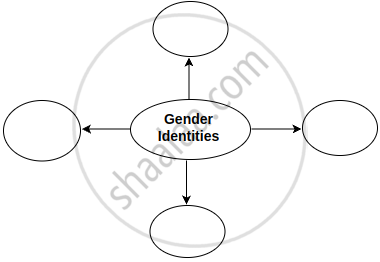
Complete the concept map.

Complete the concept map.
| GENDER CATEGORIES | (a) ______ |
| (b) ______ | |
| (c) ______ | |
| (d) ______ |
State whether the following statement are true or false with reason.
Society is gradually opening up to understanding and accepting gender fluidity.
Give your personal response.
It is necessary to understand gender diversity in society?
Match the following:
| Column 'A' | Column 'B' |
| (i) Transgender | (a) Physical relationship between women and women |
| (ii) Lesbian | (b) A person who is attracted to both sexes |
| (iii) Bisexual | (c) Homosexuality |
| (iv) Gay | (d) Lack of compatibility with a person's physical sexuality and mental sexuality |
Correct the incorrect pair and rewrite it.
The constitution of India has approved of ______ official languages.
Identify the appropriate term from the given options and rewrite it against the given statement.
Promotes healthier relationships.
______ has classified the population of India into six main racial groups.
Complete the concept map: