Advertisements
Advertisements
Question
Write a short essay (about 500 words) on the following:
Describe some ofthe distinctive features of Mohenjodaro.
Advertisements
Solution
Planned City: Harappa as a planned urban centre. It had two parts. One part of the city was small. It was built on a higher place.
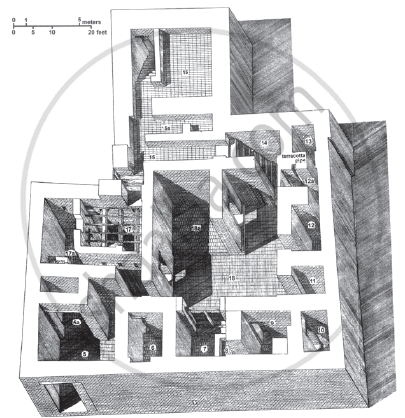
The second part was comparatively large. It was built on a lower place. The first part was designed as citadel and the second part was as lower town. The citadel owed its height to the fact that it was built on mud brick platforms.It had walls on all sides and these walls were separated from the lower town.The Lower Town: It was also a walled town.Most of the buildings were built on platforms.
In fact, these platforms were considered as foundation stones. It required huge quantity of labour force to build these platforms. It is obvious that settlement was first planned and then implemented as per the building plan.Quality of sun-dried bricks or baked bricks also prove the concept of planning.
All the bricks were of standard ratio. The length and width was four times and twice the height of the bricks respectively. These bricks were used in the settlements of the Harappan Civilisation.
Drainage System: The drainage system was well planned. All the roads and streets were laid out on a grid pattern. They intersected one another at the right angles. It seems that streets featuring drains were laid out first and houses were built thereafter along with them. To make the flow of domestic water, every house had at least one wall along the street.
The Citadel: There were many buildings in the citadel. These buildings were used for many special public purposes. The Warehouse and the Great Bath were the two most important constructions.
APPEARS IN
RELATED QUESTIONS
Which town in Indus Valley Civilisation had no Citadel?
Consider the following statements regarding the features of the Harappan settlements.
- The Harappan settlements were often small.
- They had no large buildings
- Harappan settlements had a well-planned network of roads.
- Drainage system was the key feature of the Harappan settlements.
Which of the following statements is/are correct?
Match the Harappan site with the state in which it is located.
| (a) | Lothal | (i) | Haryana |
| (b) | Kalibangan | (ii) | Gujarat |
| (c) | Harappa | (iii) | Rajasthan |
| (d) | Banawali | (iv) | Pakistan |
Which of these is the feature of Harappan Civilisation?
In the domestic architecture of Harappa there were no windows in the walls along the ground level. Identify the possible cause mentioned by the archaeologists from the following options.
Carefully examine the map of the Citadel area of Mohenjodaro and answer the question that follows:

Identify the two most important buildings located in the citadel area of Mohenjodaro.
Carefully examine the map of the Citadel area of Mohenjodaro and answer the question that follows:
According to the assumption of most of the historians, the purpose of the Great Bath must have been: ______
Carefully examine the map of the Citadel area of Mohenjodaro and answer the question that follows:
Choose the correct option.
Assertion(A): Citadel was smaller but higher part of Mohenjodaro.
Reason(R): It is on the citadel that we find evidence of structures that were probably used for special public purposes.
Carefully examine the map of the Citadel area of Mohenjodaro and answer the question that follows:
Consider the following statements :
a) The Great Bath was a large round tank.
b) There were two flights of stairs on the north and the south of the tank.
Choose the correct option:
Where was a public bath and a warehouse found in the Indus Valley during excavation?
The Archaeologist Rakhal Das Banerji discovered which of the following?
'The Great Bath' and 'The Great Granary' belong to which site?
Which of the following is the only Indus city without a citadel?
Describe any three features of the Harrapan drainage system.
'Mohenjodaro was a planned Urban Centre.' Support the statement with suitable arguments.
Describe the town planning of Harappa.
Consider the following statements regarding Harappan Culture and choose the correct option.
- The most unique feature was the development of urban centres.
- The settlements were divided into two sections i.e. the citadel and the lower town.
- Drainage system was ordinary and unplanned.
- Roads were not laid out along a grid pattern.
Describe any three features of the ‘Great Bath’ used in the Harappan settlements.
