Advertisements
Advertisements
Question
Write a short note.
Comparison of the climate of India and Brazil.
Advertisements
Solution
- India has a monsoon type of climate whereas Brazil experiences a wide range of variations in climate. For E.g. In Brazil, near the equator, the climate is hot while near the Tropic of Capricorn, there is a temperate type of climate.
- In India, the average temperature is higher throughout the year since the sun’s rays are perpendicular upto the Tropic of Cancer which passes through it whereas in Brazil, the Equator cuts across the northern part of the country which results in 25° C to 28° C of average temperature in the Amazon Valley.
- The temperature in the northern states of India is cold. For e.g. Jammu & Kashmir and parts of mountainous regions of Himalayas experience temperatures of –40° C during the winters. While the temperature increases towards the southern states of India. In contrast, the northern part of Brazil is generally hot while in the southern part, the temperature is comparatively lower.
- India receives rainfall due to the South-west monsoon winds and the rainfall is mainly of Orographic type whereas Brazil receives the orographic type of rainfall from the South-east Trade winds & North-east Trade winds and the rainfall in the northern part of Brazil is of Convectional type.
- In India, the regions of Gujarat and Rajasthan experience less rainfall while the northeastern part of the Brazilian Highlands receives very less rainfall.
- In India, Tropical cyclones occur frequently while these cyclones occur rarely in Brazil.
APPEARS IN
RELATED QUESTIONS
Choose the right answer from the alternative given below.
Which one of the following causes rainfall during winters in north-western part of India?
State whether right or wrong. Rewrite the wrong sentence.
India faces tropical cyclones frequently.
Shrub vegetation is found in ______.
Match the Column I with Column II.
| Column I | Column II | |
| A. | Equable climate | Climatic barrier |
| B. | Western Ghats | Windward side |
| C. | Peninsular region | British climate |
| D. | Manglore | Leeward side |
| E. | bengaluru | Maritime climate |
The pressure belts and the wind systems follow the apparent movements of the ______.
Which important endangered animal is found in the jungles of Assam and West Bengal?
What are the main causes that have created a major threat to the natural environment?
Find out which songs, dances, festivals and special food preparations are associated with certain seasons in your region. Do they have some commonality with other regions of India?
Observe the following graph and answer the questions given below:
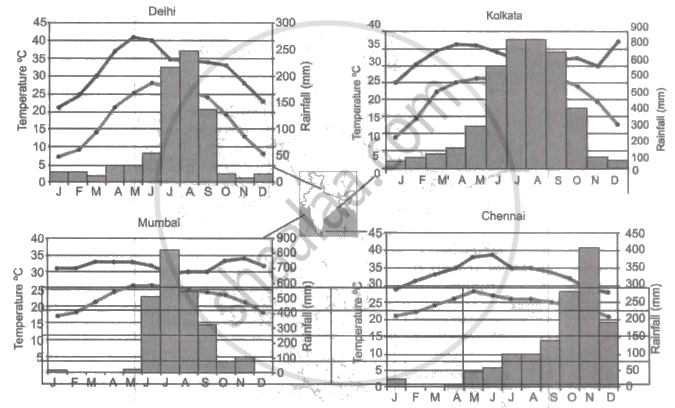
Note: In the graphs, the dark line represents the max. temperature and the lighter line represents min. temperature. The bars represent the amount of rainfall every month in each city.
- Where in the four cities is the rainfall heaviest?
- Which city has the most rainfall throughout the year?
- Which city experiences the highest temperature?
- Calculate the average range of minimum and maximum temperature for all four cities.
- What do the temperature curves in Delhi indicate?
- What is the condition of Mumbai during monsoons?
Why is it that the houses in the Tarai region and in Goa and Mangalore have sloping roofs?
