Advertisements
Advertisements
Question
Write a scientific reason.
Metallic character goes on decreasing while going from left to right in a period.
Advertisements
Solution
- An atom's metallic nature is characterised by its propensity for losing electrons.
- Electrons are added to the same outermost shell as they move from left to right over time. At the same time, protons are added to the nucleus, increasing its charge.
- As a result of the higher effective nuclear charge, these electrons are attracted to the nucleus more strongly.
- As a result, it is more difficult to remove a valence electron from an atom.
Hence, metallic character goes on decreasing while going from left to right in a period.
RELATED QUESTIONS
Answer the following in respect of element `31/15 P `
What is its valency?
Give the trend in metallic character:
(i) across the period left to right
Explain the following:
Group 17 elements are strong non-metals, while group 1 elements are strong metals.
An element X belong to 3rd periods and group II of the periodic table state:
whether it is a metal or a non-metal.
Complete the following sentences
Moving across a ………….. of the periodic table the elements show increasing ………………..character (group, period, metallic, non-metallic).
Explain why the following statement is not correct:
All groups contain metals and non metals.
Study the extract of the Periodic Table given below and answer the questions that follow. Give the alphabet corresponding to the element in question. DO NOT repeat an element. 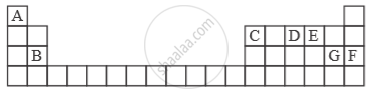
Which non-metallic element has the valency of 2?
Among the elements of the second period, Li to Ne, pick out the element that is the most reactive metal
In the third period, which is the most metallic and most non-metallic element?
Supply the missing word from the words given in brackets.
If an element has one electron in its outermost energy level, then it is likely to be _ (metallic, non metallic)
Within a group, where would you expect to find the element with the greatest metallic character.
Arrange the following elements in order of their decreasing metallic character.
Na, Si, Cl, Mg, Al
The tendency of an element to form cation is the ______ character of that element.
Write scientific reason.
The metallic character of elements increases while going down the groups.
Which of the following set of elements is written in order of their increasing metallic character?
The lightest liquid metal is ______
Which of the following set of elements is written in order of their increasing metallic character?
Choose the odd one out and write the reason:
The given table shows elements with the same number of electrons in its valence shell.
| Elements | A | B | C |
| m.p. | 63.0 | 180.0 | 97.0 |
Arrange them in order of increasing metallic character.
A group of elements in the periodic table is given below (Boron is the first member of the group and Thallium is the last).
Boron, Aluminium, Gallium, Indium, Thallium
Answer the following question in relation to the above group of elements:
Will the elements in the group to the right of this boron group be more metallic or less metallic in character? Justify your answer.
