Advertisements
Advertisements
Question
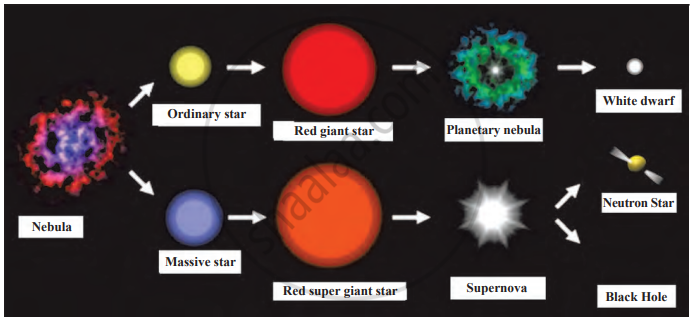
Write a paragraph on the birth and lifecycle of stars using figure.
Advertisements
Solution
The nebula is made up of gas and dust and is the birthplace of stars. Now, from this nebula, various forms of stars are formed. Some are massive stars whose size is much greater than the size of Sun and some are smaller stars whose size is smaller than the size of the Sun. Very large, massive stars burn their fuel much faster than smaller stars and may only last a few hundred thousand years. The smaller stars last for several billion years because they burn their fuel much more slowly. Other stages of a star during its life cycle.
- Sun-like Stars: These are particularly similar to the sun in size but there is a lot of variation in terms of temperature. Examples are Alpha Centuria, Tau Ceti, etc.
- Red Giants: These stars do not have a hot outer layer as that of the Sun, with temperatures ranging from 3000 oC to 4000 oC, but they have a very high luminance than the Sun. They are red in color and their diameter is 10 to 100 times that of the sun.
- SuperNova: They are larger and even brighter as compared to the red giant stars and even the Sun. They are also considered the primary source of heavy elements in the universe.
- Binary or Twin Stars: A pair of two stars in which one revolves around the other or they both revolve around a common center is known as a binary or twin star.
- Variable Stars: These stars have a variable shape and brightness, i.e., they keep changing whenever they expand or contract. Their brightness decreases when they expand and increases when they contract. Example: Polaris or Pole Star.
RELATED QUESTIONS
There are about _________ stars in our galaxy.
Name the different types of stars.
What is meant by 'The sun enters a nakshatra'?
Why do some stars appear blue and some red?
Morning star is the name given to
Sun appears to move from east to west around the earth. This means that earth rotates from
Stars appear to twinkle. Give reason.
Do stars emit light only during the night?
How is the pole star distinguished from other stars? Explain.
The temperature of the star is determined by ______.
