Advertisements
Advertisements
Question
With the help of a suitable diagram, describe the conducting system of the human heart.
Advertisements
Solution

- The human heart is myogenic, which means that it may generate a cardiac contraction through specialised conducting (nodal) tissue.
- The conducting (nodal) tissue is made up of the SA node (sino-atrial node), the AV node (atrioventricular node), and a bundle of His and Purkinje fibres.
- The SA node is located in the right atrium at the superior vena cava entrance.
- The SA node generates a contraction wave and sends it to the AV node and the left ventricle.
- The AV node is located in the right atrial wall near the base of the interatrial septum and the coronary sinus entrance. The contraction wave is sent to both ventricles by the AV node.
- A bundle of His branches begins at the AV node and travels along the interventricular septum. It divides into two branches, one for each ventricle.
- These branches form a network in the ventricle walls. Purkinje fibres are the fibres found in these branches.
- A bundle of His and Purkinje fibres transmits the contraction wave to both ventricles.
APPEARS IN
RELATED QUESTIONS
The volume of air in the lungs and the rate at which it is exchanged during inspiration and expiration was measured.
The following diagram shows a group of the lung volumes and capacities.
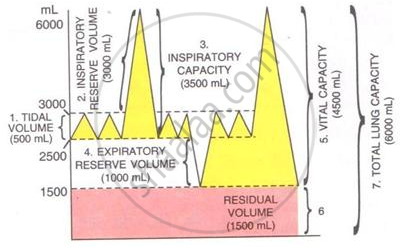
Study the diagram carefully and explain briefly the following :
Inspiratory reserve volume (IRV)
What factors are most likely to affect the breathing rate?
Find the odd one out. Give a reason for your choice.
skin, heart, lung, liver, kidney
What is breathing?
Define the following:
Cough Reflex
Complete the following statement by choosing the correct alternative from those given below.
R.Q. for fat is ______.
The question has four options. Choose the correct answer:
Covering of lung is called
Define the term “Trachea”.
Identify the parts of the lower respiratory system.
Blood plasma transports oxygen in dissolved state, percentage of which is ______.
