Advertisements
Advertisements
Question
Why did Soapy not like to go to his known persons?
Advertisements
Solution
Soapy didn’t want to go to his known persons because he thought that they would ask personal questions from him. And he was not ready to answer all their questions about his life.
RELATED QUESTIONS
Answer these question in 30–40 words.
When and how did Bismillah Khan get his big break?
Explain what the reason for the following is .
Einstein seeing in Mileva an ally.
Answer the question in a short paragraph.
What difference does the author note between the flute seller and the other hawkers?
After reading the poem answer the following questions.
The poet has used a number of words which indicate 'movement' and 'sound'. Working
with your partner make a list of these words from the poem and complete the web chart.

(c.) A word or a combination of words, whose sound seems to resemble the sound it
denotes (for example: "hiss", "buzz", "etc.) is called onomatopoeia. From the words that
you have filled in the blurbs above point out these words.
Read the comic strip based on. H.G. Wells' novells.


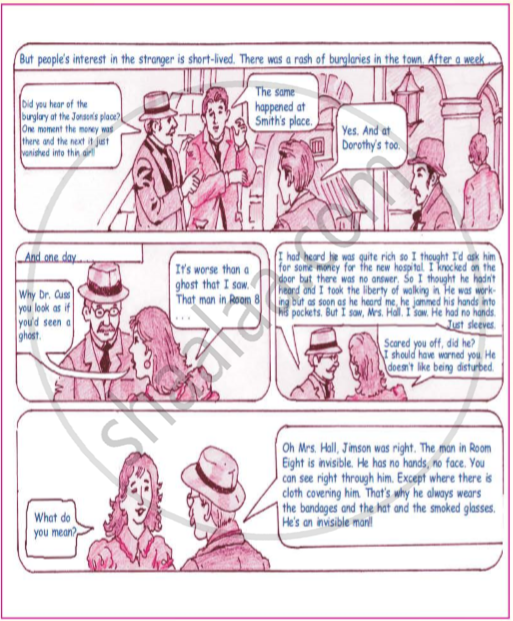
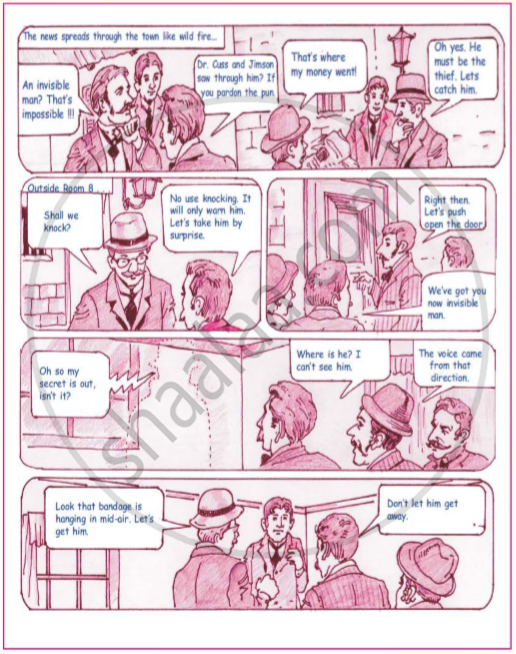
Answer the questions by ticking the correct option.
(a) The strange-looking man wanted ....
(i) the best room at the inn.
(ii} a room with a fire and a good lock.
(iii} a room with a good view.
(iv) a room where he could work quietly.
(b) Jimson was suspicious of the stranger because ...
(i} he did not answer Jimson's questions.
(ii} he did not want to talk about the weather.
(iii} he kept his back turned towards Jimson at all times.
(iv) he shouted atJimson when he entered his room.
(c) The people of the town gossiped about the stranger as ...
(i} he did not go out or talk to anyone in the town.
(ii} he had met with an accident and his face was bandaged.
(iii} he was new to the town and behaved rudely.
(iv) he stayed in his room and did not show his face to anyone.
(d) 'There was a rush of burglaries in the town. This means that ________
(i} there were many robberies in the town.
(ii) a few people in the town had seen a rob her.
(iii} the burglaries in the town were done in a rush.
(iv) the burglar was a rash and careless man.
(e) Although Jimson and Dr Cuss are suspicious of the strange guest, Mrs Hall tolerates him because ....
(i} she is not superstitious or ignorant.
(ii) she is sorry for the stranger who is bandaged.
(iii} the stranger is paying her a good amount of money for the room.
(iv} the stranger is polite and kind to Mrs Hall at all times.
(f) The stranger who was staying at the inn can be described as being ....
(I} violent
(ii} upright
(iii} dishonest
(iv) sensible
What does he plant who plants a tree? a
He plants a friend of sun and sky;b
He plants the flag of breezes free;
The shaft of beauty, towering high;
He plants a home to heaven anigh;
For song and mother-croon of bird
In hushed and happy twilight heard____
The treble of heaven's harmony_____
These things he plants who plants a tree.
Read the lines given above and answer the question that follow:
Some are meet for a maiden's wrist,
Silver and blue as the mountain mist,
Some are flushed like the buds that dream
On the tranquil brow of a woodland stream,
Some are aglow with the bloom that cleaves
To the limpid glory of new born leaves
Read the lines given above and answer the question that follow.
Pick out two simile from this stanza.
The blocks were all lined up for those who would use them
The hundred-yard dash and the race to be run
These were nine resolved athletes in back of the starting line
Poised for the sound of the gun.
The signal was given, the pistol exploded
And so did the runners all charging ahead
But the smallest among them,he stumbled and staggered
And fell to the asphalt instead.
He gave out a cry in frustration and anguish
His dreams ands his efforts all dashed in the dirt
But as sure I'm standing here telling this story
The same goes for what next occurred.
Read the lines given above and answer the following question:
Explain with reference to context.
“There were three animals altogether,” he explained. “There were two goats and a cat and then there were four pairs of pigeons.”
“And you had to leave them?” I asked.
“Yes. Because of the artillery. The captain told me to go because of the artillery.” “And you have no family?” I asked, watching the far end of the bridge where a few last carts were hurrying down the slope of the bank.
“No,” he said, “only the animals I stated. The cat, of course, will be all right. A cat can look out for itself, but I cannot think what will become of the others.”
“What politics have you?” I asked.
“I am without politics,” he said. “I am seventy-six years old. I have come twelve kilometers now and I think now I can go no further.”
“This is not a good place to stop,” I said. “If you can make it, there are trucks up the road where it forks for Tortosa.”
“I will wait a while,” he said, “ and then I will go. Where do the trucks go?” “Towards Barcelona,” I told him.
“I know no one in that direction,” he said, “but thank you very much.
Read the extract given below and answer the question that follow.
Why did the soldier tell the old man that it was not a good place to stop?
Margot stood alone. She was a very frail girl who looked as if she had been lost in the rain for years and the rain had washed out the blue from her eyes and the red from her mouth and the yellow from her hair. She was an old photograph dusted from an album, whitened away, and if she spoke at all her voice would be a ghost. Now she stood, separate, staring at the rain and the loud wet world beyond the huge glass. “What’re you looking at ?” said William. Margot said nothing. “Speak when you’re spoken to.” He gave her a shove. But she did not move; rather she let herself be moved only by him and nothing else. They edged away from her, they would not look at her. She felt them go away. And this was because she would play no games with them in the echoing tunnels of the underground city. If they tagged her and ran, she stood blinking after them and did not follow. When the class sang songs about happiness and life and games her lips barely moved. Only when they sang about the sun and the summer did her lips move as she watched the drenched windows.
Read the extract given below and answer the question that follow.
When did Margot react ?
Discuss the following topic in groups.
If you had to live in a home like Tilloo’s, what parts of life would you find most difficult? What compensations might there be?
Describe the music teacher, as seen from the window.
How did the jealous courtiers of Akbar plan to ruin Tansen?
What does the last sentence of the story suggest? What would the crocodile tell his wife?
Describe briefly to the class an improbable dream you have had.
Was it really a ghost who Vijay Singh befooled? Who do you think it was?
This story has a lot of rhyming words, as a poem does. Can you write out some parts of it like a poem, so that the rhymes come at the end of separate lines?
For example:
Patrick never did homework. “Too boring,” he said. He played baseball and hockey and Nintendo instead.
Multiple Choice Question:
What happens to the kite all of a sudden?
Multiple Choice Question:
What are hymn books”?
Who do you think is the character of rebel based on?
