Advertisements
Advertisements
Question
Answer the following question.
Why did Golu go to the river?
Advertisements
Solution
Golu went to the river to find out what the crocodile ate for dinner.
RELATED QUESTIONS
Thinking about Language
Here are some sentences from the text. Say which of them tell you, that the author:
(a) was afraid of the snake, (b) was proud of his appearance, (c) had a sense of humour,
(d) was no longer afraid of the snake.
1. I was turned to stone.
2. I was no mere image cut in granite.
3. The arm was beginning to be drained of strength.
4. I tried in my imagination to write in bright letters outside my little heart the words, ‘O
God’.
5. I didn’t tremble. I didn’t cry out.
6. I looked into the mirror and smiled. It was an attractive smile.
7. I was suddenly a man of flesh and blood.
8. I was after all a bachelor, and a doctor too on top of it!
9. The fellow had such a sense of cleanliness…! The rascal could have taken it and used it
after washing it with soap and water.
10. Was it trying to make an important decision about growing a moustache or using eye
shadow and mascara or wearing a vermilion spot on its forehead?
Has Lushkoff become a beggar by circumstance or by choice?
When we meet people, we notice their faces more than anything else. The box below contains words which describe the features of a face. Work in pairs and list them under the appropriate headings, then add more words of your own.
| twinkling | shifty | discoloured | short | oval |
| pear-shaped | large | close-cropped | broken | long |
| protruding | gapped | thick | pointed | wide |
| fair | thin | pale | swarthy | staring |
| square | round | untidy | close-set | neat |
| wavy | upturned |
| Shape of face | Complexion | Eyes | Hair | Nose | Lips | Teeth |
Look at the passage below and study how the personal pronouns refer to different people.
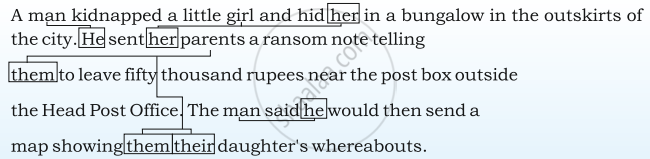
Read the following story
There lived a wise old man in Purkul, Dehradun. The villagers looked up to him and approached him for all their problems. Three naughty boys Amar, Naveen and Praveen wanted to test the old man's wisdom. One fine morning they caught a butterfly while playing in the garden. Amar had the
butterfly in his hand. He said, "We will go to the old man and ask him ifthe butterfly is dead or alive. If the old man says, 'the butterfly is dead', I will open my hands and release the butterfly. It will fly away." "If he says it is alive?" asked N aveen looking at Amar with a smirk. "I will crush the butterfly and show him the dead insect," said Amar. The three of them set forth with their wonderful plan.
Amar went to the old man and said, "Sir, the villagers say you can predict the future. Now tell us if the butterfly in my hand is dead or alive?" The old man looked at the three boys with a serene smile and said, "It is in your hands."
Some are Purple and gold flecked grey
For she who has journeyed through life midway,
Whose hands have cherished , whose love has blest,
And cradled fair sons on her faithful breast,
And serves her household in fruitful pride,
And worship the gods at her husband's side.
Read the lines given above and answer the question that follow:
The patriarchal system is referred in this stanza. Quote.
Exceeding peace had made Ben Adhem bold,
And to the presence in the room he said,
"What writest thou?"..... The vision raised its head,
And with a look made of all sweet accord,
Answered, "The names of those who love the Lord."
Read the lines given above and answer the following question.
What did the angel tell Abou bin Adhem?
The horse was nearly life-size, moulded out of clay, baked, burnt, and brightly coloured, and reared its head proudly, prancing its forelegs in the air and flourishing its tail in a loop; beside the horse stood a warrior with scythelike mustachios, bulging eyes, and aquiline nose. The old image-makers believed in indicating a man of strength by bulging out his eyes and sharpening his moustache tips, and also decorated the man’s chest with beads which looked today like blobs of mud through the ravages of sun and wind and rain (when it came), but Muni would insist that he had known the beads to sparkle like the nine gems at one time in his life.
Read the extract given below and answer the question that follow.
What destruction did the village boys do to the things near the statue?
Lights were shining from every window, and there was a savoury smell of roast goose, for it was New-year’s eve—yes, she remembered that. In a corner, between two houses, one of which projected beyond the other, she sank down and huddled herself together. She had drawn her little feet under her, but she could not keep off the cold; and
she dared not go home, for she had sold no matches, and could not take home even a penny of money. Her father would certainly beat her; besides, it was almost as cold at home as here, for they had only the roof to cover them, through which the wind howled, although the largest holes had been stopped up with straw and rags. Her little hands were almost frozen with the cold. Ah! perhaps a burning match might be some good, if she could draw it from the bundle and strike it against the wall, just to warm her fingers. She drew one out—“scratch!” how it sputtered as it burnt! It gave a warm, bright light, like a little candle, as she held her hand over it. It was really a wonderful light. It seemed to the little girl that she was sitting by a large iron stove, with polished brass feet and a brass ornament. How the fire burned! and seemed so beautifully warm that the child stretched out her feet as if to warm them, when, lo! the flame of the match went out, the stove vanished, and she had only the remains of the half-burnt match in her hand.
Read the extract given below and answer the question that follow.
How did she try to keep herself warm?
Discuss the following topic in groups.
What problems are you likely to face if you keep ants as pets?
Why did the narrator’s Grandfather visit Lucknow?
What made Ray think the visitor was not really a shopper?
Why did Vijay Singh ask the ghost to accompany him to town next day?
Why was all the ‘mystery’ spoilt?
Fill in the blank in the sentence below with the words or phrases from the box. (You may not know the meaning of all the words. Look such words up in a dictionary, or ask your teacher.)
This ____________ we are going to have a class exhibition.
In the story, Patrick does difficult things he hates to do because the elf pretends he needs help. Have you ever done something difficult or frightening, by pretending about it in some way? Tell your classmates about it.
Make noun from the word given below by adding –ness, ity, ty or y
Great ___________.
What sort of life did Dogs live a long time ago?
Write True or False against the following statement.
Nasir lives in a city.
Write a paragraph about yourself so that people who read it will get to know you better. You could write about yourself from any point of view, or choose one of the following topics.
- What I enjoy doing most
- What makes me angry
- What I hate to do
- What I want to become
(Remember to give reason or details of what you write about so that anyone reading it will understand you better.) After you have finished your paragraph affix your photo on the sheet and display it on the wall. Read each other’s paragraphs. Did you understand someone else better after you had read what he/she wrote?
