Advertisements
Advertisements
Question
While studying her family’s history. Shikha discovers records of ancestors 12 generations back. She wonders how many ancestors she has had in the past 12 generations. She starts to make a diagram to help her figure this out. The diagram soon becomes very complex.
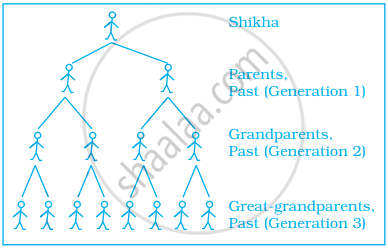
- Make a table and a graph showing the number of ancestors in each of the 12 generations.
- Write an equation for the number of ancestors in a given generation n.
Advertisements
Solution
a. On the basis of given diagram, we can make a table that shows the number of ancestors in each of the 12 generations.
| Generations | Ancestors |
| 1st | 2 |
| 2nd | 22 |
| 3rd | 23 |
 |
 |
| 12th | 212 |
Hence, we can also make a graph that shows the relation between generation and ancestor.

b) On the basis of generation-ancestor graph, the number of ancestors in n generations will 2n.
APPEARS IN
RELATED QUESTIONS
Express the given numbers in usual form.
3 × 10⁻⁸
Express the given numbers in usual form.
5.8 × 10¹²
Express the following numbers in standard form:
0.00000000000943
Express the following numbers in standard form:
846 × 107
Write the following numbers in the usual form:
5.8 × 10²
Express the following number in standard form.
4050000
Express the following number in the usual form.
The usual form for 2.03 × 10⁻⁵ is ______.
The usual form for 2.3 × 10⁻¹⁰ is ______.
At the end of the 20th century, the world population was approximately 6.1 × 10⁹ people. Express this population in usual form. How would you say this number in words?
