Advertisements
Advertisements
Question
Which of the following are benzylic alcohols?
(i) \[\ce{C6H5 - CH2 - CH2OH}\]
(ii) \[\ce{C6H5 - CH2OH}\]
(iii) \[\begin{array}{cc}
\ce{C6H5 - CH - OH}\\
\phantom{}|\phantom{.}\\
\phantom{..}\ce{CH3}\phantom{}
\end{array}\]
(iv) \[\begin{array}{cc}
\ce{C6H5 - CH2 - CH - OH}\\
\phantom{.......}|\phantom{}\\
\phantom{.........}\ce{CH3}\phantom{}
\end{array}\]
Advertisements
Solution
(ii) \[\ce{C6H5 - CH2OH}\]
(iii) \[\begin{array}{cc}
\ce{C6H5 - CH - OH}\\
\phantom{}|\phantom{.}\\
\phantom{..}\ce{CH3}\phantom{}
\end{array}\]
Explanation:
In these alcohols, the –OH group is attached to a sp3- hybridised carbon atom next to an aromatic ring. For example,
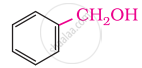
Primary
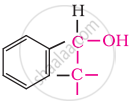
Secondary
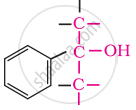
Tertiary
Allylic and benezlic alcohols may be primary, secondary or tertiary.
APPEARS IN
RELATED QUESTIONS
Write the main product(s) in each of the following reactions:

Write the structures of A, B, C, D and E in the following reactions:

Give the equation of the following reaction:
Bromine in CS2 with phenol.
Write the reaction involved in the following:
Friedal-Crafts Alkylation of Phenol
When phenol is treated with excess bromine water, it gives:
On distilling phenol with Zn dust, one gets:
In the reaction of phenol with CHCl3 and aqueous NaOH at 343 K, the electrophile attacking the ring is:
When Phenol is distilled with zinc dust, it gives:
The electrophile involved in Reimer-Tiemann reaction of phenol with CHCl3 in presence of NaOH:
Which of the following species can act as the strongest base?
Which of the following compounds is aromatic alcohol?
| (A) | ![]() |
| (B) | ![]() |
| (C) | ![]() |
| (D) | ![]() |
Nitration is an example of aromatic electrophilic substitution and its rate depends upon the group already present in the benzene ring. Out of benzene and phenol, which one is more easily nitrated and why?
Convert the following:
Phenol to N-phenylethanamide.
Which of the following is not aromatic?
Attacking species in nitration of benzene in presence of fuming HNO3 is
Write the equations for the following reaction:
Phenol is treated with chloroform in the presence of NaOH
For the pair phenol and cyclohexanol, answer the following:
Give one chemical test to distinguish between the two.
Convert the following by giving a chemical equation:
Phenol to salicylaldehyde.


