Advertisements
Advertisements
Question
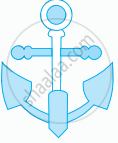
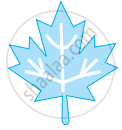
Which of the figures given below have both line and rotational symmetry?
Options


Advertisements
Solution
(a) and (c)
Explanation:
Only have both line and rotational symmetry.
In the given figure, line of symmetry will be shown as
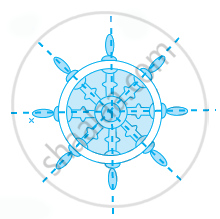
Also, rotational symmetry will be shown as
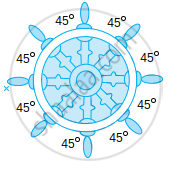
`360^circ/8` = 45°, i.e. rotational angle is equal to 45°.
In the given figure, line of symmetry will be shown as
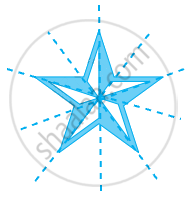
Also, rotational symmetry will be shown as
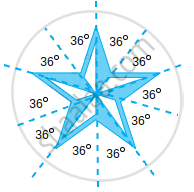
`360^circ/10` = 36°, i.e. rotational angle is equal to 36°.
APPEARS IN
RELATED QUESTIONS
Draw, wherever possible, a rough sketch of a triangle with only line symmetry and no rotational symmetry of order more than 1.
If a figure has two or more lines of symmetry, should it have rotational symmetry of order more than 1?
Fill in the blanks:
| Shape | Centre of Rotation | Order of Rotation | Angle of Rotation |
| Square | |||
| Rectangle | |||
| Rhombus | |||
| Equilateral Triangle | |||
| Regular Hexagon | |||
| Circle | |||
| Semi-circle |
Look at the following shapes:
c) Try and change the shapes below in such a way that they look the same on the `1/3` turn.
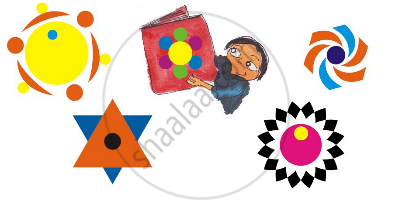
Draw some shapes which will look the same after the `1/3` turn.
Draw some shapes which will look the same after the `1/6` turn.
Can we have a rotational symmetry of order more than 1 whose angle of rotation is 45°?
In the following figure, write the number of lines of symmetry and order of rotational symmetry.

[Hint: Consider these as 2-D figures not as 3-D objects.]
In the following figure, write the number of lines of symmetry and order of rotational symmetry.

[Hint: Consider these as 2-D figures not as 3-D objects.]
In the following figure, write the number of lines of symmetry and order of rotational symmetry.

[Hint: Consider these as 2-D figures not as 3-D objects.]
