Advertisements
Advertisements
Question
Which hormones regulate menstrual cycle?
Advertisements
Solution
The menstrual cycle is regulated by a complex interplay of hormones such as follicle-stimulating hormone (FSH), luteinising hormone (LH), estrogen, and progesterone. During the follicular phase, levels of FSH and LH secreted from the anterior pituitary begin to rise. FSH, guided by gonadotropin-releasing hormone (GnRH) from the hypothalamus, helps primary follicles grow into Graafian follicles.
As the follicle matures, it begins to secrete estrogen, which leads to the proliferation of the endometrial lining of the uterus. Estrogen also provides positive feedback to stimulate the surge of LH this LH surge causes ovulation, i.e., the rupture of the Graafian follicle and release of the ovum.
The ruptured follicle transforms into the corpus luteum, which secretes progesterone during the luteal phase. Progesterone helps in maintaining the endometrium and preparing it for possible implantation of the embryo.
If fertilisation does not occur, progesterone levels drop, the corpus luteum degenerates, and the endometrium sheds, marking the onset of menstruation. High levels of progesterone also inhibit FSH and LH, thereby preventing further ovulation in that cycle.
APPEARS IN
RELATED QUESTIONS
the biological/technical terms for Fixing of developing zygote on the uterine wall.
Define the following term :
Ovulation
What is menstrual cycle? Describe it in brief.
Explain the changes that occur in the ovary and uterus during menstrual cycle in human females. Mention the influence of pituitary and ovarian hormones in bringing these changes.
Explain the menstruation phases in the menstrual cycle of a human female.
Give Reasons
The chances of pregnancy to occur are most favourable on or about the 14th day of the menstrual cycle. Explain.
Name the Following
The onset of menstruation in a young girl at about the age of 13 years.
Multiple choice question.
Rupturing of follicles and discharge of ova is known as _______.
Lack of which hormone results in menstrual flow?
Progesterone peaks during which phase of the menstrual cycle?
Calculate the number of spermatozoa produced by a single primary spermatocyte.
When does the following step take place?

____________ is transformed to corpus luteum during luteal phase of the menstrual cycle.
Identify the INCORRECT statement.
Corpus luteum develops under the influence of ______.
In the human female, menstruation can be deferred by the administration of ______.
Which one of the following statements is incorrect about menstruation?
Which one of the following events is correctly matched with the time period in a normal menstrual cycle?
To answer the question, study the graphs below for Subjects 1 and 2 showing different levels of certain hormones.
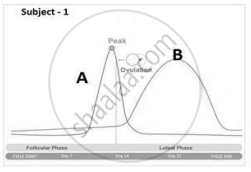
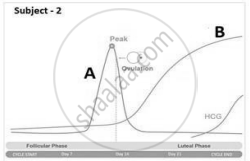
The peak observed in Subject 1 and 2 is due to ______
In case the ova does not fertilize, which of the following events will take place?
Menstruation normally occurs once in ______.
The growth of corpus luteum is initiated by:
Identify the correct statement from the following:
Describe hormonal control in various phases of the menstrual cycle.
In the figure given below, parts A and B show the level of hormones which influence the menstrual cycle. Study the figure and answer the questions that follow:
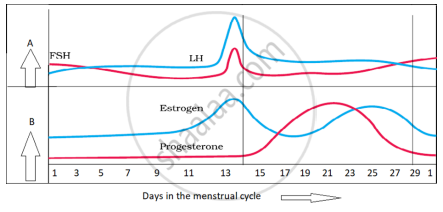
- Name the organs which secrete the hormones represented in parts A and B.
- State the impact of the hormones in part B on the uterus of the human female during 6 to 15 days of the menstrual cycle.
The figure show a section of human ovary. Select the option which gives the correct identification of either A or B with function/characteristic.
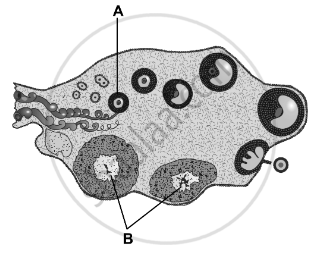
Which of the following statement is correct?
Choose the odd one out from the following terms and name the category to which the others belong:
The onset of menstruation in women is called ______.
Match Column I and Column II with respect to the menstrual cycle.
| Column I | Column II |
|---|---|
| i. Menstrual phase | c. Secretion of inhibin |
| ii. Follicular phase | b. Development of the primary follicle |
| iii. Ovulatory phase | a. Rapid secretion of LH |
| iv. Secretory phase | d. Secretion of estrogen |
Choose the correct option.
