Advertisements
Advertisements
Question
Which has less electrical resistance : a thin wire or a thick wire (of the same length and same material)?
Advertisements
Solution
A thick wire has a greater area of cross-section, whereas a thin wire has a smaller area of cross-section. Also, the resistance of a conductor is inversely proportional to its area of cross-section. This means that a thick wire has lesser resistance than a thin wire.
APPEARS IN
RELATED QUESTIONS
On what factors does the resistance of a conductor depend?
Why are copper and aluminium wires usually employed for electricity transmission?
Fill in the following blanks with suitable words:
Copper is a good .......... Plastic is an ..........
What is meant by conductors and insulators? Give two examples of conductors and two of insulators.
What is the general name of the substances having infinitely high electrical resistance?
Distinguish between good conductors, resistors and insulators. Name two good conductors, two resistance and two insulators.
What is meant by the "resistance of a conductor" ? Write the relation between resistance, potential difference and current.
Which has more resistance:
a thick piece of nichrome wire or a thin piece?
What will be the resistance of a metal wire of length 2 metres and area of cross-section 1.55 × 10⁻⁶ m2 if the resistivity of the metal be 2.8 × 10⁻⁸ Ω m?
How does the resistance of a conductor depend on:
length of the conductor?
What would be the effect on the resistance of a metal wire of:
increasing its length?
What would be the effect on the resistance of a metal wire of:
increasing its diameter?
What would be the effect on the resistance of a metal wire of:
increasing its temperature?
Calculate the area of cross-section of a wire if its length is 1.0 m, its resistance is 23 Ω and the resistivity of the material of the wire is 1.84 × 10⁻⁶ Ω m.
The figure blow shows a variable resistor in a dimmer switch.
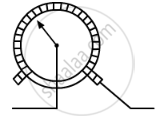
How would you turn the switch to make the lights: (a) brighter, and (b) dimmer? Explain your answer.
How will you infer with the help of an experiment that the same current flows through every part of the circuit containing three resistors R1, R2 and R3 in series connected to a battery of V volts?
Materials which allow larger currents to flow through them are called:

Plastic insulation surrounds a wire having diameter d and length l as shown above. A decrease in the resistance of the wire would be produced by an increase in the ______.
