Advertisements
Advertisements
Question
Which of the following ideas did not form part of the early phase of India’s development policy ?
Options
Planning
Liberalisation
Cooperative farming
Self sufficiency
Advertisements
Solution
Liberalisation
APPEARS IN
RELATED QUESTIONS
What were the major differences in the approach towards development at the time of Independence? Has the debate been resolved?
“Indian policy makers made a mistake by emphasising the role of state in the economy. India could have developed much better if private sector was allowed a free play right from the beginning”. Give arguments for or against this proposition.
The Socialist model of development was related to ______.
In India, planning was conceived as the main instrument of ______.
NITI AYOG was established on ______.
Tripura State Planning Board was set up in ______.
Engagement of local people in development project refers to ______.
The entire process of participatory development can be completed in ______.
The form of Participation where the primary stakeholders participate in the discussion and analysis of pre-determined objectives is called ______.
Which state was carved out of Assam from the following?
The leader and the country that helped to reach the Tashkent agreement between India and Pakistan.
______ Policy has been adopted by NITI Aayog.
Study the picture given below and answer the question that follows:

Choose the first state to be created due to linguistic demands after independence:
Observe the figure below and answer accordingly.
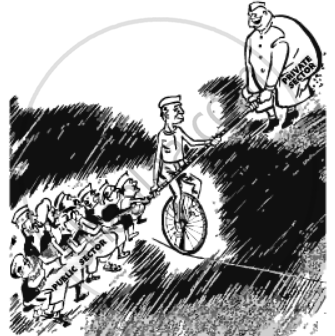
Why has a big tilt towards the public sector been shown in the cartoon?
Read the following paragraph and answer according.
NITI Aayog or National Institution for Transforming India Aayog is basically a policy think tank of Government of India and State Governments that replaces the 65-year old Planning Commission.
The Union Government of India had announced formation of NITI Aayog on 1st January, 2015. The body is composed of a CEO and a Vice Chairperson, to be appointed by the Prime Minister, in addition to some full-time members and two part-time members, while four Union Ministers would serve as ex-officio members.
Besides, there would be specific regional councils, while experts and specialists from various fields would be called as special invitees nominated by the Prime Ministers.
NITI Aayog will serve as a “think tank” of the government as a “directional and policy dynamo” and would provide both to the governments at the centre and in the states with strategic and technical advice on key policy matters including economic issues of national and international importance.
NITI Aayog will have regional councils to focus on developmental activities on specific areas and is patterned on the National Reforms Development Commission of China.
The CFO and Vice Chairperson of NITI Aayog is appointed by ______.
The Planning Commission was established in the year
Which of the following ideas did not form part of the early phase of India's development policy?
Following are a few points given on the approach towards development at the time of Independence. Which of them is correct?
- The common perception of Development was becoming modernized which involved the breakdown of traditional social structure
- After independence India had two models of development one was Europe's and US's liberal capital model and the other USSR's socialist model.
- Many including the Communist Party of India and leaders like Nehru. were impressed by the Soviet model and very few favored the American models.
Read the following passage and answer the question.
"In the early years of Independence, two contradictory tendencies were already well advanced inside the Congress Party. On the one hand, the national party executive endorsed socialist principles of state ownership, regulation, and control over key sectors of the economy in order to improve productivity and at the same time curb economic concentration. On the other hand, the national Congress ·government pursued liberal economic policies and incentives to private investment that was justified in terms of the sold criterion of achieving a maximum increase in production". - Francine Frankel
What is the contradiction that the author is talking about? What would be the political implications of a contradiction like this?
Which of the following option is correct?
What is the meaning and importance of economic planning in the Indian context?
Which two model of development India had adopted on the eve of independence?
Who was the first vice chairperson of NITI Aayog?
Which factor was responsible for discouraging research and development in the manufacturing sector?
The idea of planning in India was drawn from
- The Bombay Plan
- Experiences of the Soviet Bloc countries
- Gandhian vision of Society
- Demand by Peasant organizations
Which one of the following is not the objective of NITI Aayog?
