Advertisements
Advertisements
Question
When two thin lenses of focal lengths f1 and f2 are kept coaxially and in contact, prove that their combined focal length ‘f’ is given by: `1/f = 1/f_1 + 1/f_2`
Advertisements
Solution
Let two thin lenses L1 and L2 of focal lengths f1 and f2 be put in contact. O is a point object at a distance u from the lens L1 Its image is formed at I after refraction through the two lenses at a distance v from the combination. The lens L1 forms the image of O at I’. I’, then serves as a virtual object for the lens L2 which forms a real image at I.
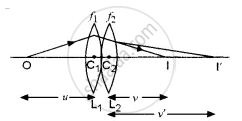
Now, we know that by lens formula
`1/v - 1/u = 1/f`
Applying this relation for refraction at the lens
L1 of focal length f1 can be written as
`1/v' - 1/u = 1/f_1` ...(i)
For refraction at the lens L2
u = v', v = v
∴ For this lens `1/v - 1/v' = 1/f_2` ...(ii)
And if F is the focal length of the combination, then
`1/v - 1/u = 1/F`
Adding (i) and (ii), we get
`1/v' - 1/u + 1/v - 1/v' = 1/f_1 + 1/f_2`
or `1/v -1/u = 1/f_1 + 1/f_2`
or `1/"F" = 1/f_1 + 1/f_2 `
