Advertisements
Advertisements
Question
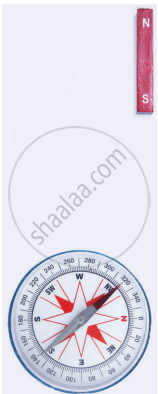
When the pole of a bar magnet is brought close to a magnetic compass, the bar magnet and the compass needle (which is also a magnet) exert a magnetic force on each other. As per Newton’s third law of motion, both the forces are equal in magnitude and opposite in direction. However, the compass needle moves, whereas the bar magnet does not move (Fig.). Explain why.
Advertisements
Solution
The bar magnet and the compass needle exert equal and opposite magnetic forces on each other, as indicated by Newton’s third law of motion. However, these equivalent forces do not result in equal accelerations since the masses of the two objects are different.
Newton’s second law of motion is that
`a = F/m`
Acceleration is inversely proportional to mass for the same force. Because the compass needle has a very small mass, the force causes it to accelerate significantly and move. The same force causes a very tiny acceleration in the bar magnet because of its much bigger mass. As a result, although the compass needle moves, the bar magnet seems to stay at rest.
