Advertisements
Advertisements
Question
What would you observe in the following case?
Concentrated sulphuric acid is added to equal volumes of cold water.
Advertisements
Solution
When concentrated sulphuric acid is added to equal volume of cold water it limit down the heat which is released.
APPEARS IN
RELATED QUESTIONS
How will you distinguish between dilute hydrochloric acid and dilute sulphuric acid using lead nitrate solution?
Quicklime is not used to dry HCl gas because _____.
Choose the current answer from the options given below :
When conc. H2SO4 comes in contact with sugar, it becomes black due to
What do you see when concentrated sulphuric acid is added to copper sulphate-5-water ( You are not required to say what is happing, nor is it necessary to name the products.)
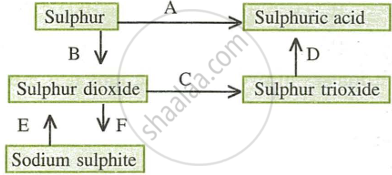
- Name the catalyst which helps in the conversion of sulphur dioxide to sulphur trioxide in step C.
- In the contact process for the manufacture of sulphuric acid, sulphur trioxide is not converted to sulphuric acid by reacting it with water. Instead a two-step procedure is used. Write the equations for the two steps involved in D.
- What type of substance will liberate sulphur dioxide from sodium sulphite in step E?
- Write the equation for the reaction by which sulphur dioxide is converted to sodium sulphite in step F.
Write the balanced chemical equation for the following conversion:
Lead sulphate from lead nitrate solution and dilute sulphuric acid.
Give two balanced reactions of the type to show the following property of sulphuric acid:
Dehydrating nature
The salt is formed when concentrated sulphuric acid reacts with KNO3 above 200°C.
Rewrite the following statement by adding the correct word, as shown in the example:
|
Example: Given Statement: Ammonia changes moist red litmus to blue. Correct Statement: Aqueous ammonia changes moist red litmus to blue. |
Sulphuric acid acts as a dehydrating agent.
Hydrogen chloride gas is prepared in the laboratory by the action of concentrated sulphuric acid on sodium chloride.
State the method of collection of the gas formed above.
