Advertisements
Advertisements
Question
What will happen to the volume of a cuboid if its Length is doubled, height is same and breadth is halved?
Advertisements
Solution
\[\text { Suppose that the length, breadth and height of the cuboid are l, b and h, respectively } . \]
\[\text { Then, volume = l } \times b \times h\]
\[\text { When its length is doubled, its length becomes 2 }\times l . \]
\[\text { When its breadth is halved, its length becomes} \frac{b}{2} . \]
\[\text { The height h remains the same } . \]
\[\text { Now, volume of the new cuboid = length } \times \text { breadth } \times\text { height }\]
\[ = 2 \times l \times \frac{b}{2} \times h\]
\[ = l \times b \times h\]
\[ \therefore \text { It can be observed that the new volume is the same as the initial volume . So, there is no change in volume } . \]
RELATED QUESTIONS
A 4 cm edge cube is cut into 1 cm edge cubes. Calculate the total surface area of all the small cubes.
Each edge of a cube is increased by 50%. Find the percentage increase in the surface area of the cube.
If two cubes each of side 6 cm are joined face to face, then find the volume of the resulting cuboid.
If the length of a diagonal of a cube is `8 sqrt(3)` cm, then its surface area is
If the sum of all the edges of a cube is 36 cm, then the volume (in cm3) of that cube is
Four cubes, each of edge 9 cm, are joined as shown below :
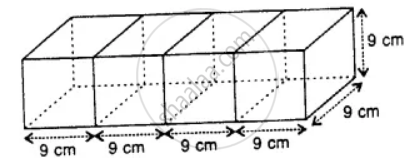
Write the dimensions of the resulting cuboid obtained. Also, find the total surface area and the volume
A room 5 m long, 4.5 m wide, and 3.6 m high have one door 1.5 m by 2.4 m and two windows, each 1 m by 0.75 m. Find :
(i) the area of its walls, excluding door and windows ;
(ii) the cost of distempering its walls at the rate of Rs.4.50 per m2.
(iii) the cost of painting its roof at the rate of Rs.9 per m2.
The capacity of a rectangular tank is 5.2 m3 and the area of its base is 2.6 x 104 cm2; find its height (depth).
The floor of a rectangular hall has a perimeter 250 m. If the cost of painting the four walls at the rate of ₹ 10 per m2 is ₹ 15,000, find the height of the hall.
The areas of any two faces of a cuboid are equal.
