Advertisements
Advertisements
Question
What was the position of the emperor in the administrative set-up?
Advertisements
Solution
The emperor enjoyed extreme powers. His decisions on all matters like military, political, administrative, and judicial were final. His word was law. He was the commander-in-chief of the armed forces and the supreme judge on all matters of justice.
APPEARS IN
RELATED QUESTIONS
Fill in the blanks:
In the year _________ Akbar defeated Rana Pratap in the Battle of _______.
Match Column A with Columb B:
| A | B |
| 1. Bairam Khan | (a) religious faith started by Akbar |
| 2. Abul Fazi | (b) incharge of the revenue |
| 3. Todar Mal | (c) musician of Akbar's court |
| 4. Tansen | (d) guardian of Akbar |
| 5. Din-i-ilahi | (e) author of Akbarnama |
State whether the following statement is True or False:
Raja Todar Mai was the Revenue Minister of Akbar.
State whether the following statement is True or False:
Akbar allowed religious freedom to the Rajputs only.
What do you understand by the term Din-i-Ilahi? Write a brief note on it.
Rana Udai Singh of Mewar rejected Akbar’s offer of friendship and refused to submit to him. In this context, discuss:
Subjugation of Rana Udai Singh
Answer the following question briefly:
Mention any two important social reforms introduced by Akbar?
The picture depicts a Mughal emperor holding discussions on religious matters in the Ibadat Khana.
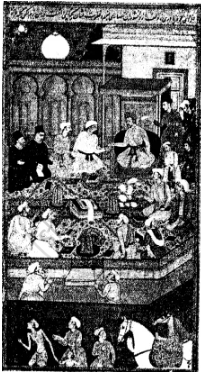
Identify the emperor.
Discuss Akbar’s revenue system with reference to Survey and assessment of land
How did the revenue system benefit the state and the farmers?
