Advertisements
Advertisements
Question
What was the extent of Akbar’s kingdom? How was administration carried out during Akbar’s time? Explain with reference to the Central and Provincial administration.
Advertisements
Solution
Akbar’s empire extended from Bengal in the east to Afganistan in the west and from the Himalayas in the north to the Godavari river in the south. His vast empire was divided into fifteen provinces. They were Kabul, Lahore, Multan, Delhi, Agra, Allahabad, Oudh, Gujarat, Ajmer, Malwa, Bihar, Bengal, Khandesh, Berar, Ahmednagar. The Akbar administration was divided into Central and Provincial administration.
Central Administration The emperor was assisted by a team of ministers and officials for the proper administration of the empire. Their names and functions are as follows:
- Wazir Dewan: He was the head of the revenue department.
- Mir Bakshi: He was the head of the military department and the paymaster of all mansabdars.
- The Qazi: He was the chief judge.
- Chief Sadr: He was the supervisor of the royal household.
- Vakil: He was the head of the advisory board.
Provinical Administration: Akbar’s empire was divided into fifteen provinces or Subas, which-were further subdivided into Sarkars, and these in turn into Parganas. Each Pargana comprised a number of villages. Each province was under the charge of a subedar, who had full civil and military powers. The Subehdar was assisted by a number of officials like provincial Diwan, Bakshi, Qazi, kotwal and a number of other officials.
APPEARS IN
RELATED QUESTIONS
Important Words:
Diwan-i-Aam
Fill in the blank:
__________ was built to celebrate Akbar’s victory over Gujarat.
State whether the following statement is True or False:
Raja Todar Mai was the Revenue Minister of Akbar.
Do you think architecture flourished during Akbar’s reign? Give reasons for your answer.
The land revenue system introduced by Akbar was known as the ______.
Choose the correct answer:
Akbar founded a new religious order which he called_______.
State whether the following is true or false:
Din-i-Ilahi was adopted by all the people in Akbar’s empire.
Answer the following question briefly:
Give an account of Akbar’s cultural achievements with reference to Architecture
The picture depicts a Mughal emperor holding discussions on religious matters in the Ibadat Khana.
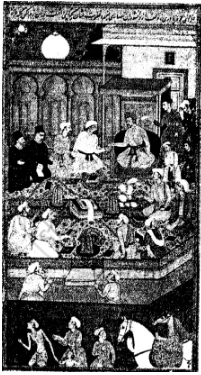
Why did the emperor organize these assemblies?
Discuss Akbar’s revenue system with reference to Revenue calculation
