Advertisements
Advertisements
Question
Advertisements
Solution
APPEARS IN
RELATED QUESTIONS
Name the two characteristics of sound which differentiate two sounds from each other.
Give two examples each of longitudinal waves and transverse waves.
When we change a feeble sound to a loud sound, we increase its :
The speed of sound in air at 0°C is nearly :
The heart of a man beats 75 times a minute. What is its (a) frequency and (b) time period?
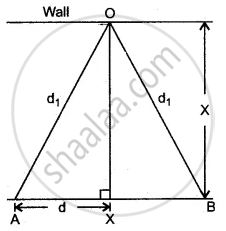
A cannon is fired at A (see diagram). An observer at B hears two sounds. The first sound is heard after 1 second and the second 3s after the observer sees the flash. (Velocity of sound = 340 ms−1)
(i) Why does the observer see the flash before he hears the sound?
(ii) Calculate the distance x between the observer and the wall.
What is approximate value of the speed of sound in iron as compared to that in air? Illustrate your answer with a simple experiment.
Name the factors on which the speed of sound depends.
Match the following.
| 1. | Tuning fork | The point where density of air is maximum |
| 2. | Sound | Maximum displacement from the equilibrium position. |
| 3. | Compressions | The sound whose frequency is greater than 20,000 Hz. |
| 4. | Amplitude | Longitudinal wave. |
| 5. | Ultasonics | Production of sound. |
