Advertisements
Advertisements
Question
What is meant by 'rusting of iron'? With the help of labelled diagrams, describe an activity to find out the conditions under which iron rusts.
Advertisements
Solution
Iron objects, kept in moist air for a long period of time, react with moist air to form a reddish brown crumbling substance called rust (hydrated iron (III) oxide, Fe2O3. X H2O, where X is the number of moles of water that differs). This corrosion of iron metal by reacting with moist air is called the rusting of iron.
Conditions essential for the rusting of iron:
1. Presence of air (oxygen)
2. Presence of water (moisture)
Let us do an activity to prove that moist air is necessary for the rusting of iron.
Experiment: Take three test tubes and place a dirt-free iron nail in each of these test tubes (refer to the figure below). In the first test tube, anhydrous calcium chloride is added and the test tube is closed. In the second test tube, distilled water and a layer of oil is added and the test tube is closed with a cork. In the third test tube, tap water is added. The nail is dipped into water in such a way that a part of it is exposed to the damp air present inside the test tube.

Observation:
(i) The nails in the first and the second test tube do not rust.
ii) The nail present in the third test tube rusts.
Conclusion:
Hence, we can conclude that both air and water are necessary for the rusting of iron.
APPEARS IN
RELATED QUESTIONS
Tinning : Tin : : Galvanizing : _________
What special name is given to the corrosion of iron?
Fill in the following blank with suitable word:
The corrosion of copper produces a .............. coating of basic copper carbonate on its surface
What is the corrosion of iron known as?
What are the constituents of stainless steel?
In stainless steel alloy, iron metal is mixed with:
(a) Cu and Cr
(b) Cr and Ni
(c) Cr and Sn
(d) Cu and Ni
Mention two uses of the following metals and non-metals
Iron
Name the metal which is a constituent of plant pigment?
Write scientific reasons.
Lemon or tamarind is used for cleaning copper vessels turned greenish.
Give reason.
A wooden article should be polished.
Explain the term – rusting and give a word equation for the formation of rust. If polished iron nails are kept in three separate test tubes, state the contents in each test tube required, to prove the conditions for rusting.
Stainless steel is an alloy of _______.
Draw a neat labelled diagram.
Anodizing
Write a molecular formula for rust.
Observe the following figure and write the answer of the question.
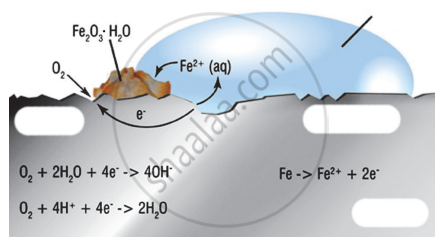
- Which process is shown in the figure?
- Explain the chemical reaction shown in the figure.
- Write the reactions on anode and cathode.
Which among the following alloys contain mercury as one of its constituents?
The diagram shows the reaction between metal and dil. acid.

What is the reason for different behaviour of Mg in test tube B?
Identify the correct statement from the following:
State whether the following statement is true or false:
Ships suffer a lot of damage though they are painted.
Give an example of a chemical reaction for the following situation:
Sound is produced
