Advertisements
Advertisements
Question
What is vegatative reproduction? Describe any 'three' natural methods of vegetative reproduction with examples?
Advertisements
Solution
Vegetative reproduction is a kind of asexual reproduction which occurs with the help of vegetative organs like root, stem, leaf, or bud.
A. Root Tuber: e.g. Sweet Potato (Ipomoea batatas)
- It is a modification of the root for vegetative reproduction.
- These roots develop from the nodes of the stem.
- They become tuberous and fleshy for the storage of food. In addition to the storage of food, these roots also develop adventitious buds on their surface which sprout under favourable conditions to produce ‘leafy shoot’ and adventitious roots.
- Under suitable environmental conditions, these leafy shoots separate and develop into new plants.

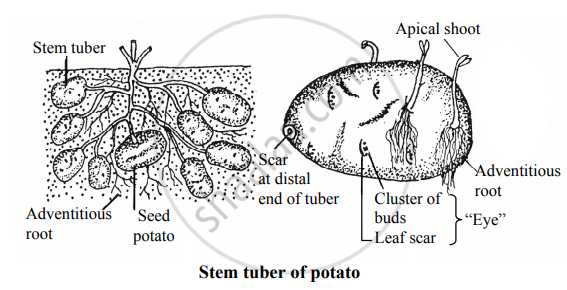
B. Stem tuber: e.g. Solanum tuberosum
- A stem tuber is a modified stem for vegetative reproduction.
- In the case of potatoes, some lateral branches are produced from the underground part of the stem which grows down in the soil.
- The tip of these branches store food and hence are swollen.
- A stem tuber has many notches on its surface called ‘eye’.
- The eyes that are seen on the surface of the tuber represent nodes.
- Each ‘eye’ is actually a node and is made up of one or more axillary buds subtended by a leaf scar.
- Under favourable conditions, axillary buds develop into new plants.
C. Vegetative propagation by runner: e.g. Cynodon
- The runner is a slender, prostrate, subaerial branch with short or long internode and creeps horizontally on the soil.
- Runner develops from the axillary bud in the axil of the lowest leaf.
- After creeping some distance, away from the parent plant, it produces shoots from the upper side and roots from the lower side of the nodes.
- Many runners are produced by the parent plant which may get detached from the parent plant to develop into new plants.

APPEARS IN
RELATED QUESTIONS
Why is this mode practiced for growing some types of plants?
A slender, prostrate, subaerial branch of the stem which creeps along the ground used in vegetative reproduction is ______
Vegetative propagation refers to formation of new plants from ______
In a potato, vegetative propagation takes place by ______
Vegetatively propagated plants ______
Which of the following is not an artificial method of vegetative propagation?
Boojho had the following parts of a rose plant – a leaf, roots, a branch, a flower, a bud and pollen grains. Which of them can be used to grow a new rose plant?
Roots are used in vegetative propagation of ______.
List two advantages of vegetative propagation technique.
The plants that can be raised by the method of vegetative propagation are ______.
