Advertisements
Advertisements
Question
What is inelastic collision? In which way it is different from an elastic collision. Mention a few examples in day-to-day life for inelastic collision.
Advertisements
Solution
Inelastic collision: In a collision, the total initial kinetic energy of the bodies (before the collision) is not equal to the total final kinetic energy of the bodies (after collision) then, it is called as inelastic collision, i.e.,
Total kinetic energy before collision ≠ Total kinetic energy after collision
`("Total kinetic energy after collision") - ("Total kinetic energy before collision") = ("loss in energy during collision") = DeltaQ`
Even though kinetic energy is not conserved but the total energy is conserved. This is because the total energy contains the kinetic energy term and also a term ∆Q, which includes all the losses that take place during a collision. Note that loss in kinetic energy during collision is transformed to another form of energy like sound, thermal, etc. Further, if the two colliding bodies stick together after collision such collisions are known as completely inelastic collision or perfectly inelastic collision. Such a collision is found very often. For example when a clay putty is thrown on a moving vehicle, the clay putty (or Bubblegum) sticks to the moving vehicle and they move together with the same velocity.
Difference between Elastic & inelastic collision
| S.No. | Elastic | Inelastic |
| 1. | Total kinetic energy is conserved. | Total kinetic energy is not conserved. |
| 2. | The forces involved are conservative forces. | The forces involved are non-conservative forces. |
| 3. | Mechanical energy is not dissipated. | Mechanical energy is dissipated into heat, light, sound, etc. |
APPEARS IN
RELATED QUESTIONS
State if the following statement is true or false. Give a reason for your answer.
In an elastic collision of two bodies, the momentum and energy of each body is conserved.
Answer carefully, with reason:
Is the total linear momentum conserved during the short time of an elastic collision of two balls?
A bullet of mass 0.012 kg and horizontal speed 70 m s–1 strikes a block of wood of mass 0.4 kg and instantly comes to rest with respect to the block. The block is suspended from the ceiling by means of thin wires. Calculate the height to which the block rises. Also, estimate the amount of heat produced in the block.
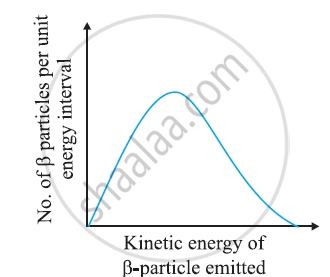
Consider the decay of a free neutron at rest : n → p + e–
Show that the two-body decay of this type must necessarily give an electron of fixed energy and, therefore, cannot account for the observed continuous energy distribution in the β-decay of a neutron or a nucleus
A ball of mass 0.1 kg makes an elastic head-on collision with a ball of unknown mass, initially at rest. If the 0 .1 kg ball rebounds at one-third of its original speed, the mass of the other ball is ______.
A body of mas 'm' moving with speed 3 m/s collides with a body of mass '2m' at rest. The coalesced mass will start to move with a speed of ______.
A bullet fired from gun with a velocity 30 m/s at an angle of 60° with horizontal direction. At the highest point of its path, the bullet explodes into two parts with masses in the ratio 1:3. The lighter mass comes to rest immediately. Then the speed of the heavier mass is
The bob A of a pendulum released from horizontal to the vertical hits another bob B of the same mass at rest on a table as shown in figure.
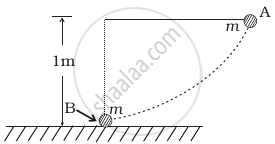
If the length of the pendulum is 1 m, calculate
- the height to which bob A will rise after collision.
- the speed with which bob B starts moving. Neglect the size of the bobs and assume the collision to be elastic.
A bag of sand of mass 9.8 kg is suspended by a rope. A bullet of 200 g travelling with speed 10 ms-1 gets embedded in it, then loss of kinetic energy will be ______.
What is a collision?
