Advertisements
Advertisements
Question
What is he “a fairly successful hand” at?
Advertisements
Solution
He was “a fairly successful hand” at stealing and robbing people.
APPEARS IN
RELATED QUESTIONS
Who does ‘I’ refer to in this story?
What does he get from Anil in return for his work?
What does he say about the different reactions of people when they are robbed?
Does Anil realize that he has been robbed?
What are Hari Singh’s reactions to the prospect of receiving an education? Do they change over time? (Hint: compare, for example, the thought: “I knew that once I could write like an educated man there would be no limit to what I could achieve” with these later thoughts: ‘Whole sentences, I knew, cloud one day bring me more than a few hundred rupees. It was a simple matter to steal − and sometimes just as simple to be caught. But to be a really big man, a clever and respected man, was something else.”) What makes him return to Anil?
Why does not Anil hand the thief over to the police? Do you think most people would have done so? In what ways is Anil different from such employers?
Answer the following question in 30-40 words:
What made Hari Singh come back to Anil?
Complete the web diagram.
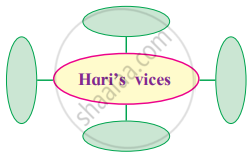
Pick out from the story 3 or 4 examples of Code-mixing (Indian words used in English).
Anil kept Hari as a cook because ______.
Why did Anil employ Hari as a cook, although he could not afford to pay him?
What did Hari learn from Anil in the beginning?
Why didn’t Anil hand over Hari to the police? What effect would it have had on Hari?
What tact had Anil used to change Hari’s dishonest ways?
Write a character sketch of ‘Hari Singh’ with the help of the following points, using the paragraph format.
|
Hari Singh’s background His dishonesty His aspirations His courage to change himself |
Fiction writers prefer creating grey characters rather than black and white. Analyse this in detail, with reference to both the characters of The Thief’s Story.
Imagine that Hari Singh from ‘The Thief’s Story’ by Ruskin Bond, writes a diary entry, exploring the theme of human values and relations that are essential in life and can transform a person in the context of his own experience. Write this diary entry as Hari Singh.
