Advertisements
Advertisements
Question
What happens when
Common salt solution is added to silver nitrate solution and NH3 solution add to it.
Advertisements
Solution
Common salt solution is added to silver nitrate solution.
AgNO3(aq) + NaCl(aq) → AgCl(s) + NaNO3(aq)
Common salt is NaCl, in aqueous medium it ionizes to form Na+ and Cl- ions.
NaCl(aq) → Na+(aq) + Cl-(aq)
Cl-(aq) + Ag+(aq) → AgCl(s)
On adding ammonia solution to it, the silver chloride gets dissolved and the following reaction occurs:
AgCl(s) + 2NH3(aq) → [Ag(NH3)2]+(aq) + Cl-(aq)
APPEARS IN
RELATED QUESTIONS
Write an equation for the following conversions A, B, C and D.
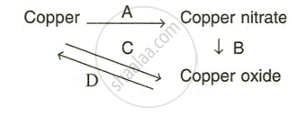
How will you prepare the following from nitric acid?
Sodium nitrate
The nitrate salt which does not give a mixture of NO2 and O2 on heating is ______.
Why is freshly prepared ferrous sulphate solution used in the ring test?
What happens when (Given balanced equation):
Nitric acid is added to Kl (aq)?
Fill in the blank with appropriate word/words.
3 Cu + 8 HNO3 (dilute) → _______ + 4H2O + _________
Complete and balance the following equation:
Cu + HNO3 → NO2 + ________+ _________
Name (formula is not acceptable) the gas produced in the following reaction:
By the action of concentrated nitric acid on copper.
Copy and complete the following table relating to important industrial processes output refers to the product of the process not the intermediate steps.
| Name of process | Inputs | Catalyst | Equation for catalysed reaction | Output |
| Haber process | Hydrogen + | |||
|
Ammonia + |
Nitric acid |
Why should the temperature of the reaction mixture of nitric acid not be allowed to rise above 200oC?
