Advertisements
Advertisements
Question
What did monks do in monasteries?
|
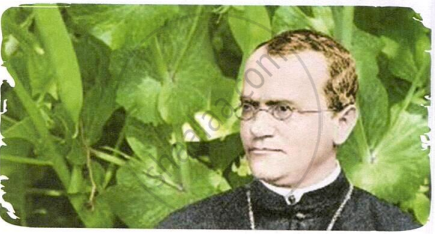
You learned in the chapter that monasteries became centres of science and learning. Here is an example of it. Gregor Mendel (1822-1884) was a monk in Augustinian Abbey of St Thomas in Brno, Moravia region (within the modern Czech Republic) where he worked as a teacher. In his spare time, Mendel experimented on pea plants and noted down the changes. He concluded that genes come in pairs and are inherited as distinct units, one from each parent. He tracked the segregation of parental genes and their appearance in the offspring as dominant or recessive traits. He recognised the mathematical patterns of inheritance from one generation to the next. It took eight years for Mendel to complete the genetic experiments. During this period, he grew more than 10,000 pea plants, keeping track of progeny number and type. Mendel published his results in 1865. He is known as ‘Father of Genetics’. |

Advertisements
Solution
Monks lived a disciplined life in monasteries and spent their time in prayer, study, teaching, and research. Monasteries became important centres of learning and science. Monks copied manuscripts, preserved knowledge, and taught students.
Some monks, like Gregor Mendel, also carried out scientific experiments. Mendel experimented on pea plants in a monastery and discovered the basic laws of heredity. Thus, monks contributed greatly to education, science, and the spread of knowledge in medieval Europe.
