Advertisements
Advertisements
Question
What are the different types of water?
Advertisements
Solution
The different types of water present in soil can be classified as:
- Gravitational water: The water which percolates deep in the soil, due to gravity is called ‘gravitational water’. This water goes beyond the reach of roots of most of the plants, thus is not available to plants for absorption.
- Hygroscopic water: Hygroscopic water refers to the thin film of water that tightly adheres to soil particles due to adsorption forces. This type of water is usually not available to plants because it is held too firmly by the soil particles. Hygroscopic water is the moisture that clings to the surface of soil particles through adsorption.
- Combined water: Water present in the form of hydrated oxides of silicon, aluminium, etc., is called ‘combined water’. It is also not available to plants for absorption.
- Capillary Water: Capillary water refers to the moisture that is retained in the soil and is held around the soil particles by capillary forces. This type of water is essential for plant growth as it is the primary source of water available to plant roots. Capillary water is the water that remains in the soil after gravitational water has drained away. It is held in the small pores of the soil due to surface tension and adhesion to soil particles.
RELATED QUESTIONS
Water present in the form of hydrated oxides of Silicon, Aluminium is called ______.
Fine soil particles imbibe or absorb water and hold it. This is called as _______.
Define the following:
Gravitational water
______ refers to the water that percolates deep in the soil due to the gravity.
In soil, ______is available for absorption by plant roots.
The water present in the fine spaces of small non-colloidal soil particles is called ______ water.
Identify labels I, II, III in the given figure of root showing different regions.
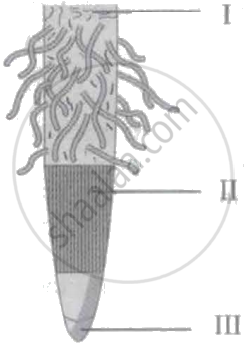
Due to which ·of the following reason root cap has no function in water absorption?
Plants absorb water from the ______.
______ is available to the plants for absorption.
