Advertisements
Advertisements
Question
What are the different stages of water cycle?
Advertisements
Solution
Stage 1: Evaporation – The heat of the sun falls on the water bodies like Ocean, Sea, Lakes, Rivers, etc. The water slowly evaporates as vapours into the air.
Stage 2: Condensation – As the vapours rise high, the cooler temperatures make them cool down and turn back into liquid. This is called condensation. Wind and air move the liquid around, leading to the formation of clouds.
Stage 3: Precipitation – Wind movements cause the clouds particles to collide. They become rain-bearing clouds and fall back onto the earth’s surface by the process known as precipitation. This may occur in the form of rain, hail, snow, or sleet depending upon the temperature conditions.
Stage 4: Runoff and Infiltration – The water either runs off into oceans, rivers, and ground surface or is absorbed into the soil (infiltration). This cycle continues.
APPEARS IN
RELATED QUESTIONS
How are the clouds formed?
Mention two main functions of water for living organisms.
Choose the correct answer.
In the water cycle _____
Observe the given graph carefully and answer the questions.
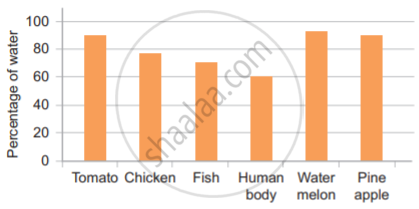
- What percentage of water is seen in fish?
- Name the food item that has maximum amount of water in its content.
- Name the food item that has minimum amount of water in its content.
- Human body consists of about ______ percentage of water.
- Specify the food item that can be consumed by a person when he/she is suffering from dehydration.
The process of changing water vapour into water is called ______.
1 inch of rainfall on a 2000 sq. ft. roof is equal to 4,800 liters of water.
Fill in the blanks in the given passage.
The rainwater and ______ from other sources such as rivers and ponds seeps through the ______ and fills the empty spaces and cracks deep below the ground. The process of seeping of water into the ground is called ______.
What are the three stages in the water cycle?
The process of the water cycle that is related to the plants is called ______.
How are clouds and fogs formed?
