Advertisements
Advertisements
Question
What are sieve tubes? Explain.
Advertisements
Solution
- Sieve tubes are long tube like conducting elements in the phloem. These are formed from a series of cells called sieve tube elements. The sieve tube elements are arranged one above the other and form vertical sieve tube.
- The end wall contains a number of pores and it looks like a sieve. So it is called as sieve plate. The sieve elements show nacreous thickenings on their lateral walls. They may possess simple or compound sieve plates.
- The function of sieve tubes are believed to be controlled by campanion cells In mature sieve tube, Nucleus is absent. It contains a lining layer of cytoplasm. A special protein (P. Protein = Phloem Protein) called slime body is seen in it.
- In mature sieve tubes, the pores in the sieve plate are blocked by a substance called callose (callose plug). The conduction of food material takes lace through cytoplasmic strands. Sieve tubes occur only in Angiosperms.

Different types of phloemelements
RELATED QUESTIONS
Differentiate between parenchyma, collenchyma and sclerenchyma on the basis of their cell wall.
Name the tissue that transports food in plants.
Identify the type of tissue in the vascular bundle.
Distinguish between tracheids and vessels.
What are tracheary elements? Describe their functions.
Write the functions of parenchyma, collencyma and sclerenchyma.
Name one place in a living organism where the following tissues are located:
Sclerenchyma
Differentiate between cells of Meristematic tissue and Permanent tissue
Differentiate between cells of Sclerenchyma and Parenchyma
Study the diagram given below and then answer the question that follows:
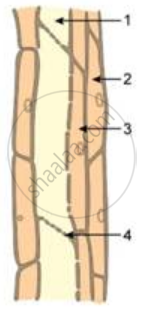
Name the parts labelled 1, 2, 3 and 4.
Study the diagram given below and then answer the question that follows:
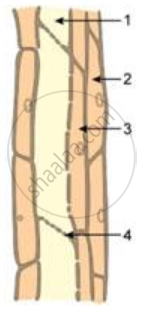
State the function of the parts labelled 1, 2, 3 and 4.
A permanent tissue is of how many types?
Give the structure and function of the following:
Sclerenchyma
The question has four answers. Choose the correct answer:
Phloem parenchyma, sclerenchyma, sieve tubes, and companion cells are found in
Write a short note on peculiarity of a sclerenchyma cell wall.
Distinguish Between Internal or anatomical difference between monocots and dicots.
Explain sclereids with their types.
Name the two types of sclerenchyma cells.
