Advertisements
Advertisements
Question
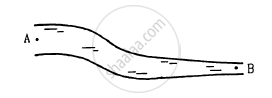
Water flows through a tube shown in figure. The area of cross section at A and B are 1 cm2 and 0.5 cm2 respectively. The height difference between A and B is 5 cm. If the speed of water at A is 10 cm s find (a) the speed at B and (b) the difference in pressures at A and B.
Advertisements
Solution
Given:
Difference in the heights of A and B = 5 cm
Area of cross section at A, aa = 1 cm2
Area of cross section at B, ab = 0.5 cm2
Speed of water at A, \[v_A\]=10 cms
(a) From the equation of continuity, we have:
\[ \vec{V}_A \times a_A = \vec{V}_B \times a_B \]
\[ \Rightarrow 10 \times 1 = \vec{V}_B \times 0 . 5\]
\[ \Rightarrow \vec{V}_B = 20 \text{ cm}/s\]
The required speed of water at cross section B is 20 cms
(b) From Bernoulli's equation, we get:
\[ \frac{1}{2}\rho v_A^2 + ρ g h_A + P_A = \frac{1}{2}\rho v_B^2 + ρ g h_A + P_B \]
\[ \Rightarrow P_B - P_A = \frac{1}{2}\rho\left( v_A^2 - v_B^2 \right) + ρg\left( h_A - h_B \right)\]
Here,
PA and PB are the pressures at A and B, respectively.
hA and hB are the heights of points A and B, respectively.
ρ is the density of the liquid.
On substituting the values, we have:
\[P_B - P_A = \frac{1}{2} \times 1(100 - 400) + 1 \times 1000(5 . 0)\]
\[ = - 150 + 5000 = 4850 \text{ Dyne}/ {cm}^2 \]
\[ = 485 N/ m^2\]
herefore, the required pressure difference at A and B is 485 N/m2.
