Advertisements
Advertisements
Question
Verify the division algorithm i.e. Dividend = Divisor × Quotient + Remainder, in each of the following. Also, write the quotient and remainder.
| Dividend | Divisor |
| 14x2 + 13x − 15 | 7x − 4 |
Advertisements
Solution
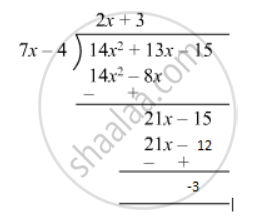
Quotient = 2x + 3
Remainder =- 3
Divisor = 7x -4
Divisor x Quotient + Remainder = (7x -4) (2x + 3) - 3
= 14x2 + 21x - 8x - 12 - 3
= 14x2 + 13x -15
= Dividend
Thus,
Divisor - Quotient + Remainder = Dividend
Hence verified.
RELATED QUESTIONS
Write each of the following polynomials in the standard form. Also, write their degree.
Divide −72a4b5c8 by −9a2b2c3.
Divide\[- x^6 + 2 x^4 + 4 x^3 + 2 x^2\ \text{by} \sqrt{2} x^2\]
Divide 4z3 + 6z2 − z by −\[\frac{1}{2}\]
Divide −21 + 71x − 31x2 − 24x3 by 3 − 8x.
Divide x5 + x4 + x3 + x2 + x + 1 by x3 + 1.
Divide the first polynomial by the second in each of the following. Also, write the quotient and remainder:
10x2 − 7x + 8, 5x − 3
Divide the first polynomial by the second in each of the following. Also, write the quotient and remainder:
x4 − x3 + 5x, x − 1
Divide the first polynomial by the second in each of the following. Also, write the quotient and remainder:
y4 + y2, y2 − 2
Find whether the first polynomial is a factor of the second.
4 − z, 3z2 − 13z + 4
