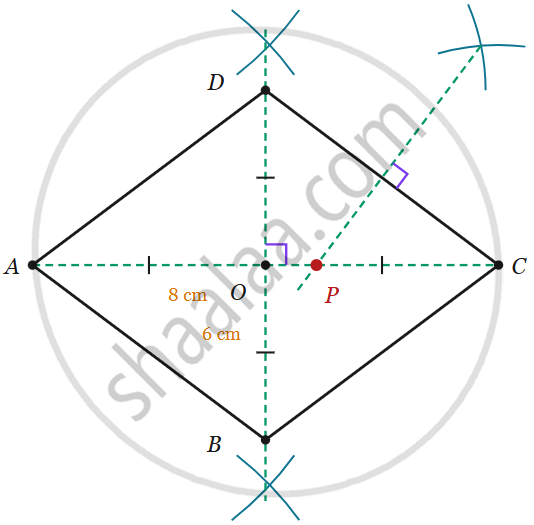
Using ruler and compasses only, construct a rhombus ABCD whose diagonals AC and BD are 8 cm and 6 cm long respectively. Find by construction, a point P equidistant from AB, AD
Advertisements
Question
Using ruler and compasses only, construct a rhombus ABCD whose diagonals AC and BD are 8 cm and 6 cm long respectively. Find by construction, a point P equidistant from AB, AD and also equidistant from C and D. Measure PC.
Advertisements
Solution
\[\begin{array}{r l} \textbf{Given:} & \text{A rhombus } ABCD \text{ whose diagonals are } AC = 8 \text{ cm and } BD = 6 \text{ cm.} \\[4pt] \textbf{To Find:} & \text{The point } P \text{ equidistant from } AB \text{ and } AD \text{ and also equidistant from } C \text{ and } D, \text{ and the length } PC. \\[4pt] \textbf{Solution:} & \text{Step 1: The diagonals of a rhombus bisect each other at right angles, so draw } AC = 8 \text{ cm, construct its perpendicular bisector meeting it at } O, \text{ cut off } OB = OD = 3 \text{ cm on it, and join } AB, BC, CD \text{ and } DA. \\[4pt] & \text{Step 2: The locus of a point equidistant from two intersecting lines is the bisector of the angle between them, and a diagonal of a rhombus bisects the vertex angle, so the locus of points equidistant from } AB \text{ and } AD \text{ is the diagonal } AC. \\[4pt] & \text{Step 3: The locus of a point equidistant from two fixed points is the perpendicular bisector of the line segment joining them, so construct the perpendicular bisector of } CD. \\[4pt] & \text{Step 4: It meets } AC \text{ at } P, \text{ which is therefore the required point, and } PC = PD. \\[4pt] & \text{Let } PC = PD = x, \text{ so that } OP = OC - PC = 4 - x, \text{ and in the right triangle } POD \text{ by Pythagoras' theorem:} \\[4pt] & \begin{aligned} PD^{2} &= OP^{2} + OD^{2} \\[4pt] x^{2} &= (4 - x)^{2} + 3^{2} \\[4pt] x^{2} &= 16 - 8x + x^{2} + 9 \\[4pt] 8x &= 25 \\[4pt] x &= \frac{25}{8} \\[4pt] &= 3.125 \\[4pt] &\approx 3.13 \end{aligned} \\[4pt] \textbf{Answer:} & P \text{ is the point where the perpendicular bisector of } CD \text{ meets the diagonal } AC, \text{ and } PC = \dfrac{25}{8} \text{ cm} \approx 3.13 \text{ cm.} \end{array}\]