English

Using Properties of Determinants, Prove That: `|(3a, -a+B, -a+C),(-b+A, 3b, -b+C),(-c+A, -c+B, 3c)|`= 3(A + B + C) (Ab + Bc + Ca) - Mathematics

Advertisements
Advertisements

Question

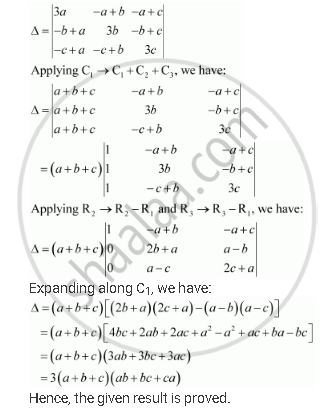
Using properties of determinants, prove that:

`|(3a, -a+b, -a+c),(-b+a, 3b, -b+c),(-c+a, -c+b, 3c)|`= 3(a + b + c) (ab + bc + ca)

Advertisements

Solution
shaalaa.com
  Is there an error in this question or solution?
Chapter 4: Determinants - Exercise 4.7 [Page 142]

APPEARS IN

NCERT Mathematics Part 1 and 2 [English] Class 12
Chapter 4 Determinants
Exercise 4.7 | Q 13 | Page 142

RELATED QUESTIONS

Using properties of determinants, prove that `|[2y,y-z-x,2y],[2z,2z,z-x-y],[x-y-z,2x,2x]|=(x+y+z)^3`


Using properties of determinants, show that ΔABC is isosceles if:`|[1,1,1],[1+cosA,1+cosB,1+cosC],[cos^2A+cosA,cos^B+cosB,cos^2C+cosC]|=0​`


Using properties of determinants, prove that

`|((x+y)^2,zx,zy),(zx,(z+y)^2,xy),(zy,xy,(z+x)^2)|=2xyz(x+y+z)^3`


If ` f(x)=|[a,-1,0],[ax,a,-1],[ax^2,ax,a]| ` , using properties of determinants find the value of f(2x) − f(x).


By using properties of determinants, show that:

`|(x,x^2,yz),(y,y^2,zx),(z,z^2,xy)| = (x-y)(y-z)(z-x)(xy+yz+zx)`


By using properties of determinants, show that:

`|(a^2+1, ab, ac),(ab, b^2+1, bc),(ca, cb, c^2+1)| = 1+a^2+b^2+c^2`


Using properties of determinants, prove that `|(1,1,1+3x),(1+3y, 1,1),(1,1+3z,1)| = 9(3xyz + xy +  yz+ zx)`


Using properties of determinants, prove the following :

\[\begin{vmatrix}1 & a & a^2 \\ a^2 & 1 & a \\ a & a^2 & 1\end{vmatrix} = \left( 1 - a^3 \right)^2\].

Using properties of determinants, prove that \[\begin{vmatrix}a + x & y & z \\ x & a + y & z \\ x & y & a + z\end{vmatrix} = a^2 \left( a + x + y + z \right)\] .


Solve for x : `|("a"+"x","a"-"x","a"-"x"),("a"-"x","a"+"x","a"-"x"),("a"-"x","a"-"x","a"+"x")| = 0`, using properties of determinants. 


Using properties of determinants, find the value of x for which
`|(4-"x",4+"x",4+"x"),(4+"x",4-"x",4+"x"),(4+"x",4+"x",4-"x")|= 0`


Evaluate the following determinants:

`|(x - 1, x, x - 2),(0, x - 2, x - 3),(0, 0, x - 3)| = 0`


Solve the following equation: `|(x + 2, x + 6, x - 1),(x + 6, x - 1,x + 2),(x - 1, x + 2, x + 6)|` =  0


Without expanding determinants, prove that `|("a"_1, "b"_1, "c"_1),("a"_2, "b"_2, "c"_2),("a"_3, "b"_3, "c"_3)| = |("b"_1, "c"_1, "a"_1),("b"_2, "c"_2, "a"_2),("b"_3, "c"_3, "a"_3)| = |("c"_1, "a"_1, "b"_1),("c"_2, "a"_2, "b"_2),("c"_3, "a"_3, "b"_3)|` 


Without expanding the determinants, show that `|(0, "a", "b"),(-"a", 0, "c"),(-"b", -"c", 0)|` = 0


Without expanding evaluate the following determinant:

`|(2, 7, 65),(3, 8, 75),(5, 9, 86)|`


Using properties of determinant show that

`|("a" + "b", "a", "b"),("a", "a" + "c", "c"),("b", "c", "b" + "c")|` = 4abc


Using properties of determinant show that

`|(1, log_x y, log_x z),(log_y x, 1, log_y z),(log_z x, log_z y, 1)|` = 0


Select the correct option from the given alternatives:

Let D = `|(sintheta*cosphi, sintheta*sinphi, costheta),(costheta*cosphi, costheta*sinphi, -sintheta),(-sintheta*sinphi, sintheta*cosphi, 0)|` then


Answer the following question:

Without expanding determinant show that

`|(0, "a", "b"),(-"a", 0, "c"),(-"b", -"c", 0)|` = 0


Answer the following question:

If `|("a", 1, 1),(1, "b", 1),(1, 1, "c")|` = 0 then show that `1/(1 - "a") + 1/(1 - "b") + 1/(1 - "c")` = 1


The value of `|(1, 1, 1),(""^"n""C"_1, ""^("n" + 2)"C"_1, ""^("n" + 4)"C"_1),(""^"n""C"_2, ""^("n" + 2)"C"_2, ""^("n" + 4)"C"_2)|` is 8.


Prove that: `|("a"^2 + 2"a", 2"a" + 1, 1),(2"a" + 1, "a" + 2, 1),(3, 3, 1)| = ("a" - 1)^3`


If A + B + C = 0, then prove that `|(1, cos"c", cos"B"),(cos"C", 1, cos"A"),(cos"B", cos"A", 1)|` = 0


The number of distinct real roots of `|(sinx, cosx, cosx),(cosx, sinx, cosx),(cosx, cosx, sinx)|` = 0 in the interval `pi/4  x ≤ pi/4` is ______.


The value of the determinant `|(x , x + y, x + 2y),(x + 2y, x, x + y),(x + y, x + 2y, x)|` is ______.


If the determinant `|(x + "a", "p" + "u", "l" + "f"),("y" + "b", "q" + "v", "m" + "g"),("z" + "c", "r" + "w", "n" + "h")|` splits into exactly K determinants of order 3, each element of which contains only one term, then the value of K is 8.


If a, b, c are the roots of the equation x3 - 3x2 + 3x + 7 = 0, then the value of `abs((2 "bc - a"^2, "c"^2, "b"^2),("c"^2, 2 "ac - b"^2, "a"^2),("b"^2, "a"^2, 2 "ab - c"^2))` is ____________.


`abs(("x", -7),("x", 5"x" + 1))`


The A.M., H.M. and G.M. between two numbers are `144/15`, 15 and 12, but not necessarily in this order then, H.M., G.M. and A.M. respectively are


The value of the determinant `|(6, 0, -1),(2, 1, 4),(1, 1, 3)|` is ______.


By using properties of determinant prove that `|(x+y,y+z,z+x),(z,x,y),(1,1,1)|` = 0.


Without expanding determinant find the value of `|(10,57,107),(12,64,124),(15,78,153)|`


Without expanding determinant find the value of `|(10,57,107),(12,64,124),(15,78,153)|`


By using properties of determinant prove that `|(x+y,y+z,z+x),(z,x,y),(1,1,1)|` = 0


Share
Notifications

Englishहिंदीमराठी


      Forgot password?
Use app×