Using only a ruler and compasses, construct ∠ABC = 120°, where AB = BC = 5 cm. a. Mark two points D and E which satisfy the condition that they are equidistant from both BA and BC.
Advertisements
Question
Using only a ruler and compasses, construct ∠ABC = 120°, where AB = BC = 5 cm.
- Mark two points D and E which satisfy the condition that they are equidistant from both BA and BC.
- In the above figure, join AE and EC. Describe the figures.
- ABCD
- BD
- ABE
Advertisements
Solution
Construct ∠ABC = 120° with AB = BC = 5 cm and draw the bisector BX of ∠ABC. D and E are two points on BX and E is taken so that BE = 5 cm.
Reason for (a): The locus of points equidistant from BA and BC is the bisector of ∠ABC. So D and E must both lie on this bisector.
Steps of construction
- Draw BC = 5 cm.
- With B as centre and a suitable radius, draw an arc cutting BC. From that point, cut off two equal arcs of the same radius to get 60° and then 120°.
- Join B to the 120° point and produce it. Cut off BA = 5 cm. Now ∠ABC = 120°.
- Bisect ∠ABC. With the points on BC and BA (at the radius used in step 2) as centres, draw arcs of equal radius cutting each other. Join B to this point and produce it as BX.
- With A as centre and radius 5 cm, cut BX at E. Mark any other point D on BX, beyond E.
- Join AE and EC, and also AD and DC.
(b) Description of the figures
- ABCD is a kite. AB = BC = 5 cm. Since D lies on the bisector of ∠ABC, triangles ABD and CBD are congruent (SAS), so DA = DC. (If (i) is meant to be ABCE, the textbook's AECB, then it is a rhombus. AB = BC = 5 cm, and BE = AE = EC = 5 cm, as the next two points show.)
- BD is the bisector of ∠ABC. It divides ∠ABC into ∠ABD = ∠DBC = 60°. It is the locus of points equidistant from BA and BC, and it is also the perpendicular bisector of AC.
- ABE is an equilateral triangle. ∠ABE = 60° and AB = AE = 5 cm, so ∠AEB = ∠ABE = 60°. All three angles are 60°, so AB = BE = AE = 5 cm.
The construction diagram follows.
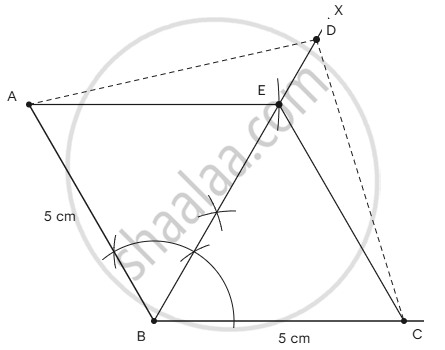
I've constructed the figure and answered both parts. The diagram shows the 120° angle, its bisector BX and the points D and E on it.
(a) D and E are two points on the bisector BX of ∠ABC, because the bisector is the locus of points equidistant from BA and BC. I placed E so that BE = 5 cm and took D further along BX, beyond E.
(b) (i) ABCD is a kite. If your book's figure is ABCE (written AECB), that is a rhombus, with all four sides 5 cm.
(b) (ii) BD is the bisector of ∠ABC. It is also the perpendicular bisector of AC.
(b) (iii) ABE is an equilateral triangle with each side 5 cm.
In the diagram, the arcs at B step off 60° twice to make the 120° angle. The two arcs that cross above give the bisector BX. The arc centred at A cuts BX at E, with AE = 5 cm. AE and EC are drawn solid, and AD and DC are dashed.
