Advertisements
Advertisements
Question
Use the clues given below to complete this crossword puzzle.
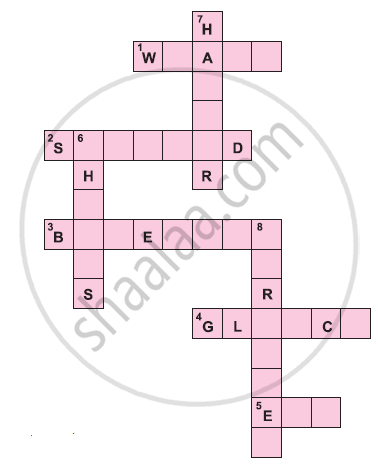
Across
1. very tired
2. had an angry look on the face
3. short trousers
4. a fault in a machine that prevents it from working properly
5. a small and naughty boy-fairy
Down
6. work that must be done every day, often boring
7. a basket with a lid
8. gave a short, high-pitched cry
Advertisements
Solution
Across
1. very tired - Weary
2. had an angry look on the face - Scowled
3. short trousers - Breeches
4. a fault in a machine that prevents it from working properly - Glitch
5. a small and naughty boy-fairy - Elf
Down
6. work that must be done every day, often boring - Chores
7. a basket with a lid - Hamper
8. gave a short, high-pitched cry - Shrieked
APPEARS IN
RELATED QUESTIONS
Go to the local library or talk to older persons in your locality and find legends in your own language. Tell the class these legends.
Thinking about the Poem
In stanza 1, find five ways in which we all are alike. Pick out the words.
What do Prashant and other volunteers resist the plan to set up institutions for orphans and widows? What alternatives do they consider?
Read the poem silently.
Two roads diverged in a yellow wood,
And sorry I could not travel both
And be one traveller, long I stood
And looked down one as far as I could
To where it bent in the undergrowth;
Then took the other, as just as fair,
And having perhaps the better claim,
Because it was grassy and wanted wear;
Though as for that the passing there
Had worn them really about the same,
And both that morning equally lay
In leaves no step had trodden black.
Oh, I kept the first for another day!
Yet knowing how way leads on to way,
I doubted if I should ever come back.
I shall be telling this with a sigh
Somewhere ages and ages hence:
Two roads diverged in a wood, and II
took the one less travelled by,
And that has made all the difference.
About the Poet
Robert Frost (1874-1963) was born in San Franscisco, Frost spent most of his adult
life in rural New England and his laconic language and emphasis on individualism in
his poetry reflect this region. He attended Dartmouth and Harvard but never earned a
degree. As a young man with a growing family he attempted to write poetry while
working on a farm and teaching in a school. American editors rejected his submitted
poems. With considerable pluck Frost moved his family to England in 1912 and the
following year, a London publisher brought out his first book. After publishing a
second book, Frost returned to America determined to win a reputation in his own
country, which he gradually achieved. He became one of the country's best-loved
poets. Unlike his contemporaries, Frost chose not to experiment with the new verse
forms but to employ traditional patterns, or as he said, he chose "the old-fashioned
way to be new." Despite the surface cheerfulness and descriptive accuracy of his
poems, he often presents a dark, sober vision of life, and there is a defined thoughtful
quality to his work which makes it unique.
Read the following and share your feelings with the class.
INTROSPECT: Realise Your Potential.
Sixteen year old Shreya, a student of XI, angrily outbursts at her parents and says, "No one likes me".
She has not been able to develop an interest in any activity, be it painting, swimming, games or studying. She is not sure what types of relationships give her comfort.
She has never had a good friend. She is not clear about her choice of career.
Shreya is good-looking, as well as physically healthy. During the interview, she was preoccupied with what others think about her.
When asked to talk about her positive qualities, she thought for a long time but could not list any. Nor was she able to mention her negative aspects.
Self Awareness
Knowing your strengths and weaknesses will help you succeed.
Knowing our helps us in acknowledging our success as well as appreciating our capacity to do something with or without support from others.
This givee us a sense of well being and we are able to learn new skills and develop assets , thereby developing our confidence. Confident people attract friends and other stable relationships.
In due course , we are ready to accept various challenges with the right kind of Investment of energy towarde task completion.
Knowing our weaknesses helps us In accepting our limitations, and developing a willingness to take help when offered and enabling us to overcome our deficits.
This paves way to expansion of skills and qualities, which prove useful ln the long run. It is worthwhile to Introspect and reflect so as to realise our potential . This help to bring about a change in us and we are able to meet challenges .
lf Shreya had introspected or had been helped by her parents or teachers to reflect on herself, she would have understood her positive and negative qualities , her likes , dislike , strengths , weakness , feelings , emotions , outlooks , choices , values and attitude towards life.
self awareness paves the way to pregress with respect to relationships , academic success , professional and personal fulfillment .
Adapted from "The Quest",
The Hindu
What does he plant who plants a tree?
He plants cool shade and tender rain,
And seed and bud of days to be,
And years that fade and flush again;
He plants the glory of the plain;
He plants the forest's heritage;
The harvest of a coming age;
The joy that unborn eyes shall see___
These things he plants who plants a tree.
Read the lines given above and answer the question that follow:
How is it the harvest of a coming age?
This woman had been despised, scoffed at, and angrily denounced by nearly every man, woman, and child in the village; but now, as the fact of, her death was passed from lip to lip, in subdued tones, pity took the place of anger, and sorrow of denunciation.
Neighbours went hastily to the old tumble-down hut, in which she had secured little more than a place of shelter from summer heats and winter cold: some with grave-clothes for a decent interment of the body; and some with food for the half-starving children, three in number. Of these, John, the oldest, a boy of twelve, was a stout lad, able to earn his living with any farmer. Kate, between ten and eleven, was bright, active girl, out of whom something clever might be made, if in good hands; but poor little Maggie, the youngest, was hopelessly diseased. Two years before a fall from a window had injured her spine, and she had not been able to leave her bed since, except when lifted in the arms of her mother.
“What is to be done with the children?” That was the chief question now. The dead mother would go underground, and be forever beyond all care or concern of the villagers. But the children must not be left to starve.
Read the extract given below and answer the question that follow.
Why was the dead woman despised and hated by all the people of the village?
I was in for a surprise. When the time came for the broad-jump trials, I was startled to see a tall boy hitting the pit at almost 26 feet on his practice leaps! He turned out to be a German named Luz Long. 1 was told that Hitler hoped to win the jump with him. I guessed that if Long won, it would add some new support to the Nazis’ “master race” (Aryan superiority) theory. After all, I am a Negro. Angr about Hitler’s ways, 1 determined to go out there and really show Der Fuhrer and his master race who was superior and who wasn’t. An angry athlete is an athlete who will make mistakes, as any coach will tell you. I was no exception. On the first of my three qualifying jumps, I leaped from several inches beyond the takeoff board for a foul. On the second jump, I fouled even worse. “Did I come 3,000 miles for this?” I thought bitterly. “To foul out of the trials and make a fool of myself ?” Walking a few yards from the pit, 1 kicked disgustedly at the dirt.
Read the extract given below and answer the question that follow.
“Did I come all the way from America for this?” I thought bitterly. “To foul out of the trials and make a fool of myself?” What does this show?
What roused the pride of the animals and made them reconcile to the new arrangement? In the meanwhile, what sudden decision was taken by the pigs? What do we learn about Napoleon at this juncture?
Answer the following question.
What happened one Sunday when the lady was going to her sister’shouse? What did the lady do? What was the bear’s reaction?
Answer the following question
How did Gopal get inside the palace to see the king after he had bought the fish?
Compare how the music teacher played the violin with that of Lalli’s.
Author’s friend had taken out the parts of the bicycle easily, but he really had tough time fixing them Explain this with suitable example.
What surprised Mr. Purcell one day?
How does father react to the mother's warning?
A. Strike off the words in the box below that are not suitable.
Taro wanted to give his old parents everything they needed.
This shows that he was …
|
thoughtful |
hardworking |
loving |
honest |
|
considerate |
trustworthy |
efficient |
kind |
Who is the speaker in the poem Whatif? What is she worried about? Can you suggest ways to get rid of silly fears?
What does the rebel do?
Study the following phrases and their meanings. Use them appropriately to complete the sentences that follow.
The police are …………… the matter thoroughly.
Study the following phrases and their meanings. Use them appropriately to complete the sentences that follow.
If you want to go out, I will ………….. the children for you.
