Advertisements
Advertisements
Question
Use graph paper for this question. Take 2 cm = 1 unit on both the axes.
- Plot the points A(1, 1), B(5, 3) and C(2, 7).
- Construct the locus of points equidistant from A and B.
- Construct the locus of points equidistant from AB and AC.
- Locate the point P such that PA = PB and P is equidistant from AB and AC.
- Measure and record the length PA in cm.
Advertisements
Solution 1

Steps of Construction:
- Plot the points A(1, 1), B(5, 3) and C(2, 7) on the graph and join AB, BC and CA
- Now we should join points A and B. Draw perpendicular bisector l of AB. Then, l is the locus of points which are equidistant from A and B.
- Now we should join A and C. Also draw the angle bisector m of ∠CAB. Then, m is the locus of points equidistant from AB and AC.
- Draw the perpendicular bisector of AB and angle bisector of angle A which intersect each other at P. P is the required point. Since P lies on the perpendicular bisector of AB. Therefore, P is equidistant from A and B.
Again,
Since P lies on the angle bisector of angle A.
Therefore, P is equidistant from AB and AC. - On measuring, the length of PA = 2.5 cm
Solution 2
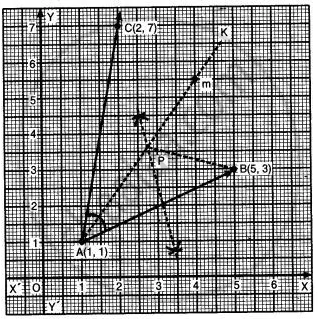
- Plot the points A(1, 1), B(5, 3) and C(2, 7) as shown.
- Join points A and B. Draw right bisector l of AB. Then, l is the locus of points equidistant from A and B.
- Join A and C. Now draw the bisector m of ∠CAB. Then, m is the locus of points equidistant from AB and AC.
- The point of intersection P of right bisector of AB and angle bisector of ∠CAB is the point such that PA = PB and P is equidistant from AB and AC.
- On measuring PA = 2.5 cm.
APPEARS IN
RELATED QUESTIONS
On a graph paper, draw the lines x = 3 and y = –5. Now, on the same graph paper, draw the locus of the point which is equidistant from the given lines.
Draw an angle ABC = 75°. Find a point P such that P is at a distance of 2 cm from AB and 1.5 cm from BC.
Construct a triangle ABC, with AB = 5.6 cm, AC = BC = 9.2 cm. Find the points equidistant from AB and AC; and also 2 cm from BC. Measure the distance between the two points obtained.
Construct a triangle ABC, with AB = 6 cm, AC = BC = 9 cm. Find a point 4 cm from A and equidistant from B and C.
Construct a triangle BCP given BC = 5 cm, BP = 4 cm and ∠PBC = 45°.
- Complete the rectangle ABCD such that:
- P is equidistant from AB and BC.
- P is equidistant from C and D.
- Measure and record the length of AB.
Construct a rhombus ABCD with sides of length 5 cm and diagonal AC of length 6 cm. Measure ∠ ABC. Find the point R on AD such that RB = RC. Measure the length of AR.
Construct a rhombus ABCD whose diagonals AC and BD are 8 cm and 6 cm respectively. Find by construction a point P equidistant from AB and AD and also from C and D.
Construct a ti.PQR, in which PQ=S. 5 cm, QR=3. 2 cm and PR=4.8 cm. Draw the locus of a point which moves so that it is always 2.5 cm from Q.
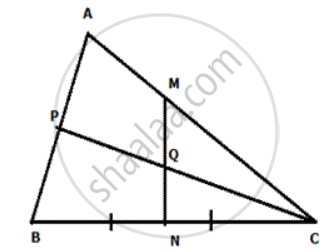
In the given figure ABC is a triangle. CP bisects angle ACB and MN is perpendicular bisector of BC. MN cuts CP at Q. Prove Q is equidistant from B and C, and also that Q is equidistant from BC and AC.
Use ruler and compasses only for the following questions:
Construct triangle BCP, when CB = 5 cm, BP = 4 cm, ∠PBC = 45°.
Complete the rectangle ABCD such that :
(i) P is equidistant from AB and BC and
(ii) P is equidistant from C and D. Measure and write down the length of AB.
