Use a graph paper for this question. A(1, 1), B(5, 1), C(4, 2) and D(2, 2) are the vertices of a quadrilateral. i. Name the quadrilateral ABCD. ii. A, B, C, D are reflected in the origin onto A', B'
Advertisements
Question
Use a graph paper for this question. A(1, 1), B(5, 1), C(4, 2) and D(2, 2) are the vertices of a quadrilateral.
- Name the quadrilateral ABCD.
- A, B, C, D are reflected in the origin onto A', B', C' and D' respectively. Locate A', B', C', D' on the graph paper and write their co-ordinates.
- Are D, A, A' and D' collinear?
Graph
Advertisements
Solution
Here’s the graph:
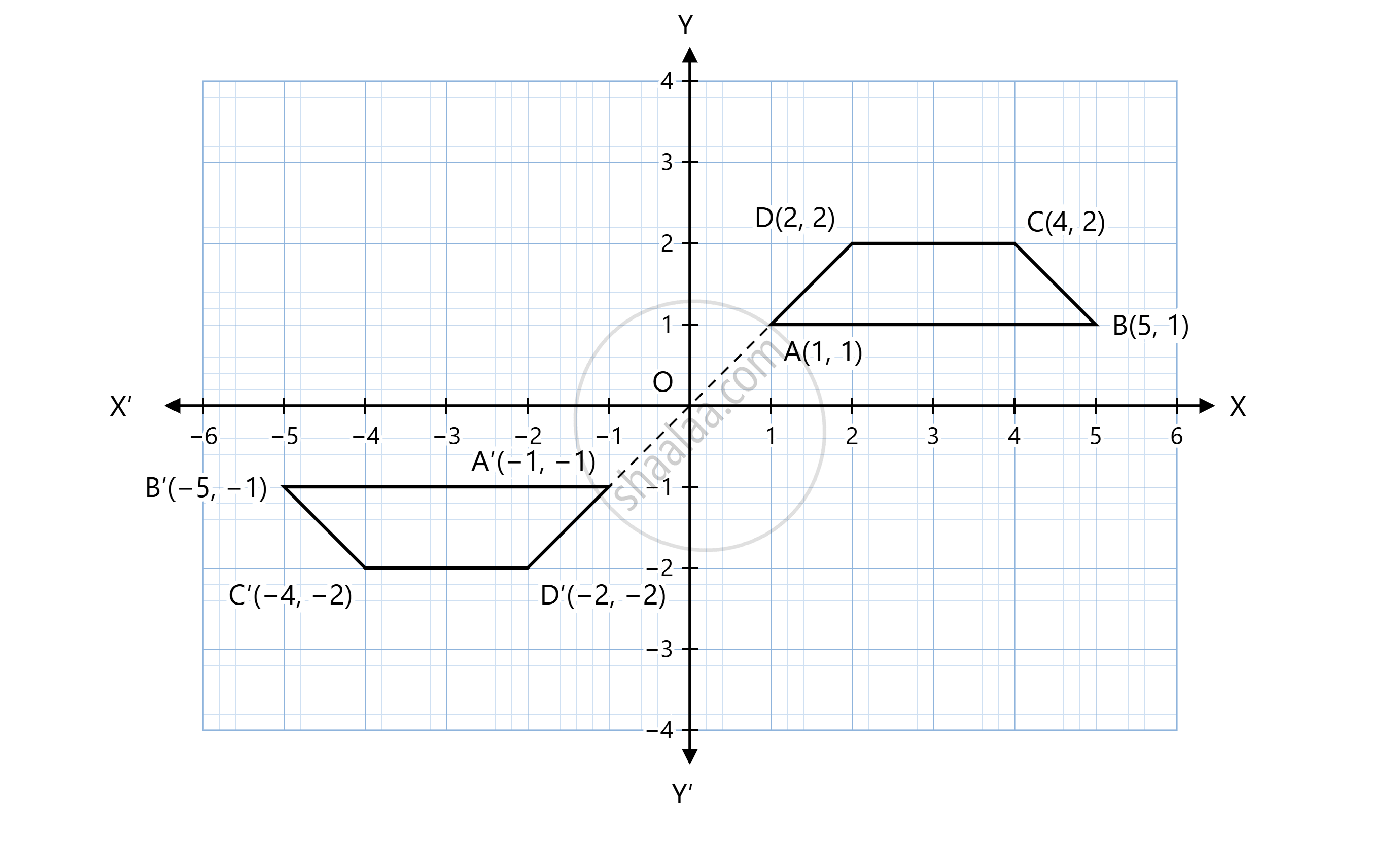
i. AB and DC are both horizontal (y = 1 and y = 2), so AB || DC. AB = 4 units and DC = 2 units, so the parallel sides are unequal. The other two sides are equal: AD = BC = `sqrt(2)` units. So ABCD is an isosceles trapezium.
ii. Reflection in the origin maps (x, y) to (–x, –y). The images are:
A′(–1, –1)
B′(–5, –1)
C′(–4, –2)
D′(–2, –2)
iii. Yes, they are collinear. In each of D(2, 2), A(1, 1), A′(–1, –1) and D′(–2, –2), the x-coordinate equals the y-coordinate. So all four points lie on the line y = x, which passes through the origin.
shaalaa.com
Is there an error in this question or solution?
