Advertisements
Advertisements
Question
Two small balls A and B, each of mass m, are joined rigidly by a light horizontal rod of length L. The rod is clamped at the centre in such a way that it can rotate freely about a vertical axis through its centre. The system is rotated with an angular speed ω about the axis. A particle P of mass m kept at rest sticks to the ball A as the ball collides with it. Find the new angular speed of the rod.
Advertisements
Solution
Let the new angular speed of the rod be ω'.
Here, net torque on the system is zero.
So, the angular momentum is conserved.
Therefore, we get
\[I\omega = I'\omega'\]
\[\left[ m \left( \frac{L}{2} \right)^2 + m \left( \frac{L}{2} \right)^2 \right]\omega = \left[ 2m \left( \frac{L}{2} \right)^2 + m \left( \frac{L}{2} \right)^2 \right]\omega'\]
\[2m L^2 \omega = 3m L^2 \omega'\]
\[ \Rightarrow \omega' = \frac{2}{3}\omega\]
APPEARS IN
RELATED QUESTIONS
A man stands on a rotating platform, with his arms stretched horizontally holding a 5 kg weight in each hand. The angular speed of the platform is 30 revolutions per minute. The man then brings his arms close to his body with the distance of each weight from the axis changing from 90cm to 20cm. The moment of inertia of the man together with the platform may be taken to be constant and equal to 7.6 kg m2.
(a) What is his new angular speed? (Neglect friction.)
(b) Is kinetic energy conserved in the process? If not, from where does the change come about?
A ball is whirled in a circle by attaching it to a fixed point with a string. Is there an angular rotation of the ball about its centre? If yes, is this angular velocity equal to the angular velocity of the ball about the fixed point?
If the angular momentum of a body is found to be zero about a point, is it necessary that it will also be zero about a different point?
A body is uniformly rotating about an axis fixed in an inertial frame of reference. Let \[\overrightarrow A\] be a unit vector along the axis of rotation and \[\overrightarrow B\] be the unit vector along the resultant force on a particle P of the body away from the axis. The value of \[\overrightarrow A.\overrightarrow B\] is _________.
A particle moves with a constant velocity parallel to the X-axis. Its angular momentum with respect to the origin ____________.
A person sitting firmly over a rotating stool has his arms stretched. If he folds his arms, his angular momentum about the axis of rotation ___________ .
If there is no external force acting on a nonrigid body, which of the following quantities must remain constant?
(a) angular momentum
(b) linear momentum
(c) kinetic energy
(d) moment of inertia.
A disc rotates about its axis with a constant angular acceleration of 4 rad/s2. Find the radial and tangential accelerations of a particle at a distance of 1 cm from the axis at the end of the first second after the disc starts rotating.
A uniform square plate of mass 2⋅0 kg and edge 10 cm rotates about one of its diagonals under the action of a constant torque of 0⋅10 N-m. Calculate the angular momentum and the kinetic energy of the plate at the end of the fifth second after the start.
Calculate the ratio of the angular momentum of the earth about its axis due to its spinning motion to that about the sun due to its orbital motion. Radius of the earth = 6400 km and radius of the orbit of the earth about the sun = 1⋅5 × 108 km.
Two particles of masses m1 and m2 are joined by a light rigid rod of length r. The system rotates at an angular speed ω about an axis through the centre of mass of the system and perpendicular to the rod. Show that the angular momentum of the system is \[L = \mu r^2 \omega\] where \[\mu\] is the reduced mass of the system defined as \[\mu = \frac{m_1 + m_2}{m_1 + m_2}\]
Suppose the platform with the kid in the previous problem is rotating in anticlockwise direction at an angular speed ω. The kid starts walking along the rim with a speed \[\nu\] relative to the platform also in the anticlockwise direction. Find the new angular speed of the platform.
A uniform rod of mass m and length l is struck at an end by a force F perpendicular to the rod for a short time interval t. Calculate (a) the speed of the centre of mass, (b) the angular speed of the rod about the centre of mass, (c) the kinetic energy of the rod and (d) the angular momentum of the rod about the centre of mass after the force has stopped to act. Assume that t is so small that the rod does not appreciably change its direction while the force acts.
Suppose the rod with the balls A and B of the previous problem is clamped at the centre in such a way that it can rotate freely about a horizontal axis through the clamp. The system is kept at rest in the horizontal position. A particle P of the same mass m is dropped from a height h on the ball B. The particle collides with B and sticks to it. (a) Find the angular momentum and the angular speed of the system just after the collision. (b) What should be the minimum value of h so that the system makes a full rotation after the collision.
A solid sphere is set into motion on a rough horizontal surface with a linear speed ν in the forward direction and an angular speed ν/R in the anticlockwise directions as shown in the following figure. Find the linear speed of the sphere (a) when it stops rotating and (b) when slipping finally ceases and pure rolling starts.
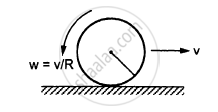
A solid sphere rolling on a rough horizontal surface with a linear speed ν collides elastically with a fixed, smooth, vertical wall. Find the speed of the sphere after it has started pure rolling in the backward direction.
