Advertisements
Advertisements
Questions
Two lamps, one rated 100 W at 220 V, and the other 60 W at 220 V, are connected in parallel to electric mains supply. What current is drawn from the line if the supply voltage is 220 V?
Two lamps, one rated 100 W; 220 V, and the other 60 W; 220 V, are connected in parallel to electric mains supply. Find the current drawn by two bulbs from the line, if the supply voltage is 220 V.
Advertisements
Solution 1
Rating 100 W; Electric current taken by 220 V lamp -
P1 = VI1
⇒ I1 = `"P"_1/"V"`
= `100/220`
= `5/11` A
Similarly, the rating is 60 W; Value of electric current taken by 220 V electric lamp -
P2 = VI2
⇒ I2 = `"P"_2/"V"`
= `60/220`
= `3/11` A
∴ Total current drawn by the electric mains
I = I1 + I2
= `5/11 + 3/11`
= `8/11` A
= 0.73 A
Solution 2
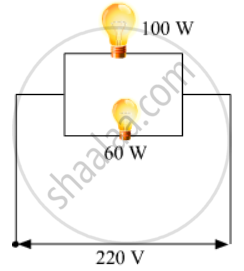
For first bulb:
P = 100 W, V = 220V
As we know, P = `v^2/R`
Thus, resistance of first bulb,
`R_1 = v^2/P`
= `220^2/100`
= 484 Ω
For second bulb:
Thus, resistance of second bulb,
`R_2 = v^2/P`
= `220^2/60`
= 806.67 Ω
Since, the two bulbs are connected in parallel, therefore
Total resistance = `(R_1R_2)/(R_1 + R_2)`
= `(484xx806.67)/(484+806.67)`
= 302.5 Ω
Hence, the current drawn by two bulbs is
I = `220/302.5`
= 0.73 A
APPEARS IN
RELATED QUESTIONS
Which quantity has the unit of watt?
An electric fan runs from the 230 V mains. The current flowing through it is 0.4 A. At what rate is electrical energy transferred by the fan?
Write an expression for the electrical power spent in flow of current through a conductor in terms of
(a) Resistance and potential difference, (b) current and resistance.
Two lamps, one rated 220 V, 50 W and the other rated 220 V, 100 W, are connected in serieswith mains of 220 V. Explain why does the 50 W lamp consume more power
An electric bulb is rated ‘100 W, 250 V’. How much current will the bulb draw if connected to a 250 V supply?
A resistor of resistance R is connected to an ideal battery. If the value of R is decreased, the power dissipated in the resistor will ______________ .
A simple electric circuit has a 30 V battery and a resistor ot 60 o. What will be the current in the circuit? The resistance of the oonnecting wires is negligible.
State the S.I. units of electrical power and electrical energy.
(i) Define the household unit of electricity.
(ii) What is the voltage of the electricity that is generally supplied to a house?
Express watt hour and kilowatt hour in joule.
An electric current is passed through a metallic wire. The wire gets heated up. Give the reason. Is it possible to melt the wire by passing a heavy current?
How does the heat produced by die passage of current in a metallic wire depend on the time of passage of current in the wire?
An electric heater is rated 220 V, 550 W. Electrical energy is also measured in kWh. What do you understand by a kilo-watt-hour?
State other bigger units of electric power and express them in watt.
The equation I2R seems to suggest that the rate of heating in a resistor is reduced if resistance decreases, whereas equation P = V2/R suggests just the opposite. How do you reconcile this problem?
1 kWh is equal to:
Electric power is inversely proportional to ____________.
What is the meaning of electric power of an electrical device? Write its SI unit.
1 kWh = ______ J.
