English
Karnataka Board PUCPUC Science Class 11

Two Ions Have Equal Masses but One is Singly-ionised and the Other is Doubly-ionised. They Are Projected - Physics

Advertisements
Advertisements

Question

Two ions have equal masses but one is singly-ionised and the other is doubly-ionised. They are projected from the same place in a uniform magnetic field with the same velocity perpendicular to the field.
(a) Both ions will move along circles of equal radii.
(b) The circle described by the singly-ionised charge will have a radius that is double that of the other circle.
(c) The two circles do not touch each other.
(d) The two circles touch each other.

Short/Brief Note
Advertisements

Solution

(b) The circle described by the singly-ionised charge will have a radius that is double that of the other circle.
(d) The two circles touch each other.

The radius of the orbit of a charged particle in an external magnetic field,
`r = (mV)/(qB)`

where r is the radius of the circle, m is the mass of the ion, V is the velocity with which the ion is projected, q is the charge on the ion and B is the uniform magnetic field.

Since the mass m, the velocity V and the magnetic field B are same for both the ions, r is inversely proportional to the charge on the ion.

Hence, the radius of the circle described by the singly-charged ion will be twice the radius of the circle described by doubly-ionised ion. 

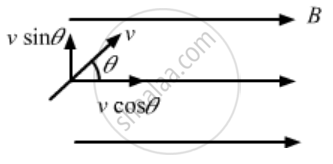
Moreover, as both the charges are projected from the same place, the two circles described by them will touch each other at the point of projection.

shaalaa.com
Force on a Moving Charge in Uniform Magnetic and Electric Fields
  Is there an error in this question or solution?
Chapter 12: Magnetic Field - MCQ [Page 230]

APPEARS IN

HC Verma Concepts of Physics Vol. 2 [English] Class 11 and 12
Chapter 12 Magnetic Field
MCQ | Q 8 | Page 230

RELATED QUESTIONS

Write the expression for the force `vecF` acting on a particle of mass m and charge q moving with velocity `vecV` in a magnetic field `vecB` , Under what conditions will it move in (i) a circular path and (ii) a helical path?


A straight wire of mass 200 g and length 1.5 m carries a current of 2 A. It is suspended in mid air by a uniform magnetic field B. What is the magnitude of the magnetic field?


A proton and a deuteron having equal momenta enter in a region of a uniform magnetic field at right angle to the direction of a the field. Depict their trajectories in the field.


A charged particle is whirled in a horizontal circle on a frictionless table by attaching it to a string fixed at one point. If a magnetic field is switched on in the vertical direction, the tension in the string


If a charged particle moves unaccelerated in a region containing electric and magnetic fields
(a) `vecE  "must be perpendicular" to vecB`
(b) `vecv "must be perpendicular" to vecE` 
(c) must be perpendicular to v_B


Two particles X and Y having equal charge, after being accelerated through the same potential difference enter a region of uniform magnetic field and describe circular paths of radii R1 and R2 respectively. The ratio of the mass of X to that of Y is ______.


An experimenter's diary reads as follows: "A charged particle is projected in a magnetic field of `(7.0 vec i - 3.0 vecj)xx 10^-3 `T. The acceleration of the particle is found to be `(x veci + 7.0 vecj )` The number to the left of i in the last expression was not readable. What can this number be?


A wire, carrying a current i, is kept in the xy plane along the curve y = A sin `((2x)/lamda x)`. magnetic field B exists in the z direction. Find the magnitude of the magnetic force on the portion of the wire between x = 0 and x = λ.


A particle of charge 2.0 × 10⁻⁸ C and mass 2.0 × 10⁻¹⁰ g is projected with a speed of 2.0 × 10³ m s−1 in a region with a uniform magnetic field of 0.10 T. The velocity is perpendicular to the field. Find the radius of the circle formed by the particle and also the time period.


An electron of kinetic energy 100 eV circulates in a path of radius 10 cm in a magnetic field. Find the magnetic field and the number of revolutions per second made by the electron.


A circular coil of radius 2.0 cm has 500 turns and carries a current of 1.0 A. Its axis makes an angle of 30° with the uniform magnetic field of magnitude 0.40 T that exists in the space. Find the torque acting on the coil.


A square coil of edge l and with n turns carries a current i. It is kept on a smooth horizontal plate. A uniform magnetic field B exists parallel to an edge. The total mass of the coil is M. What should be the minimum value of B for which the coil will start tipping over?


A narrow beam of singly-charged carbon ions, moving at a constant velocity of 6.0 × 10⁴m s−1, is sent perpendicularly in a rectangular region of uniform magnetic field B = 0.5 T (figure). It is found that two beams emerge from the field in the backward direction, the separations from the incident beam being 3.0 cm and 3.5 cm. Identify the isotopes present in the ion beam. Take the mass of an ion = A(1.6 × 10⁻²⁷) kg, where A is the mass number.


A proton is projected with a velocity of 3 × 10⁶ m s−1 perpendicular to a uniform magnetic field of 0.6 T. Find the acceleration of the proton.


A uniform magnetic field of magnitude 0.20 T exists in space from east to west. With what speed should a particle of mass 0.010 g and with charge 1.0 × 10⁻⁵ C be projected from south to north so that it moves with uniform velocity?


A particle of mass m and charge q is released from the origin in a region in which the electric field and magnetic field are given by
`vecB = -B_0 vecj and vecE = E_0 vecK `
Find the speed of the particle as a function of its z-coordinate.


An electron is emitted with negligible speed from the negative plate of a parallel-plate capacitor charged to a potential difference V. The separation between the plates is dand a magnetic field B exists in the space, as shown in the figure. Show that the electron will fail to strike the upper plates if `d > ((2m_eV)/(eB_0^2))^(1/2)`


A charged particle moves through a magnetic field in a direction perpendicular to it. Then the ______.

Current flows through uniform, square frames as shown in the figure. In which case is the magnetic field at the centre of the frame not zero?


The velocity of a body of mass 2 kg as a function of time t is given by v(t) = 2t`hat"i" + "t"^2hat"j"`. The force acting on it, at time t = 2 s is given by ______.


Share
Notifications

Englishहिंदीमराठी


      Forgot password?
Use app×