Advertisements
Advertisements
Question
Two godowns A and B have grain capacity of 100 quintals and 50 quintals respectively. They supply to 3 ration shops, D, E and F whose requirements are 60, 50 and 40 quintals respectively. The cost of transportation per quintal from the godowns to the shops are given in the following table:
| Transportation cost per quintal (in Rs) | ||
| From/To | A | B |
| D | 6 | 4 |
| E | 3 | 2 |
| F | 2.50 | 3 |
How should the supplies be transported in order that the transportation cost is minimum? What is the minimum cost?
Advertisements
Solution
Let godown A supply x and y quintals of grain to the shops D and E respectively. Then, (100 − x − y) will be supplied to shop F.
The requirement at shop D is 60 quintals since x quintals are transported from godown A. Therefore, the remaining (60 −x) quintals will be transported from godown B.
Similarly, (50 − y) quintals and 40 − (100 − x − y) = (x + y − 60) quintals will be transported from godown B to shop E and F respectively.
The given problem can be represented diagrammatically as follows.
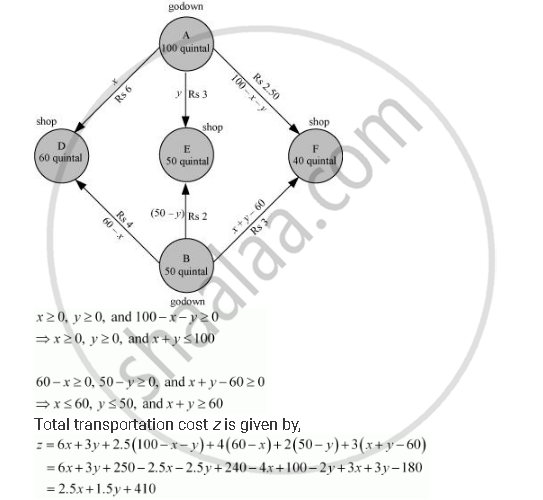
The given problem can be formulated as
Minimize z = 2.5x + 1.5y + 410 … (1)
subject to the constraints,
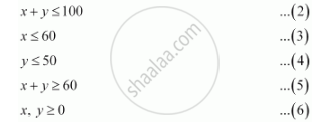
The feasible region determined by the system of constraints is as follows.
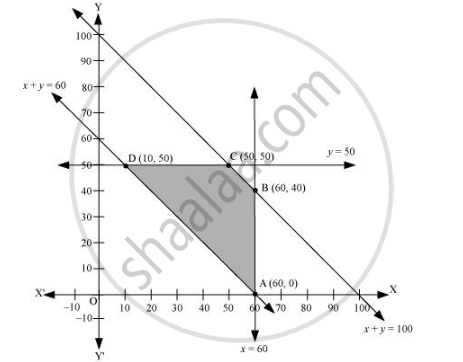
The corner points are A (60, 0), B (60, 40), C (50, 50), and D (10, 50).
The values of z at these corner points are as follows.
| Corner point | z = 2.5x + 1.5y + 41 | |
| A (60, 0) | 560 | |
| B (60, 40) | 620 | |
| C (50, 50) | 610 | |
| D (10, 50) | 510 | → Minimum |
The minimum value of z is 510 at (10, 50).
Thus, the amount of grain transported from A to D, E, and F is 10 quintals, 50 quintals, and 40 quintals respectively and from B to D, E, and F is 50 quintals, 0 quintals, and 0 quintals respectively.
The minimum cost is Rs 510.
