Advertisements
Advertisements
Question
Three-point charges Q, q and -q are kept at the vertices of an equilateral triangle of side L as shown in the figure. What is
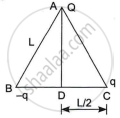
- the electrostatic potential energy of the arrangement? and
- the potential at point D?
Advertisements
Solution
- The electrostatic potential energy of the arrangement.
U = `1/(4piepsi_0)[((Q) xx (-q))/L + ((-q)(q))/L + ((q)(Q))/L]`
= `1/(4piepsi_0.L)[-qQ - q^2 + qQ]`
U = `-q^2/(4piepsi_0.L)` 
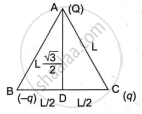
The potential at point D.
`V_D = 1/(4piepsi_0)[((-q))/(L"/"2) + q/((L"/"2)) + Q/(Lsqrt3"/"2)]`
`V_D = 1/(4piepsi_0) . (2Q)/(sqrt(3)L)`
⇒ `V_D = Q/(2sqrt3piepsi_0L)`
APPEARS IN
RELATED QUESTIONS
A small test charge is released at rest at a point in an electrostatic field configuration. Will it travel along the field line passing through that point?
What is the work done by the field of a nucleus in a complete circular orbit of the electron? What if the orbit is elliptical?
Obtain an expression for an intensity of electric field at a point at the end of position, i.e., the axial position of an electric dipole.
x
The electrostatic potential energy of two-point charges, 1 µC each, placed 1 meter apart in the air is:
Three point charges +2, +2, and +5µC are placed respectively at the vertices A, B, C of an equilateral triangle of side 0.2 m. The magnitude of the force experienced by the charge at C is ______.
If stretch in a spring of force constant k is tripled then the ratio of elastic potential energy in the two cases will be:
