Advertisements
Advertisements
प्रश्न
Three-point charges Q, q and -q are kept at the vertices of an equilateral triangle of side L as shown in the figure. What is
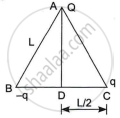
- the electrostatic potential energy of the arrangement? and
- the potential at point D?
Advertisements
उत्तर
- The electrostatic potential energy of the arrangement.
U = `1/(4piepsi_0)[((Q) xx (-q))/L + ((-q)(q))/L + ((q)(Q))/L]`
= `1/(4piepsi_0.L)[-qQ - q^2 + qQ]`
U = `-q^2/(4piepsi_0.L)` 
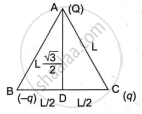
The potential at point D.
`V_D = 1/(4piepsi_0)[((-q))/(L"/"2) + q/((L"/"2)) + Q/(Lsqrt3"/"2)]`
`V_D = 1/(4piepsi_0) . (2Q)/(sqrt(3)L)`
⇒ `V_D = Q/(2sqrt3piepsi_0L)`
APPEARS IN
संबंधित प्रश्न
Obtain an expression for an intensity of electric field at a point at the end of position, i.e., the axial position of an electric dipole.
x
Why must electrostatic field be normal to the surface at every point of a charged conductor?
Two-point charges placed in a medium of dielectric constant 5 are at a distance r between them, experience an electrostatic force ‘F’. The electrostatic force between them in vacuum at the same distance r will be ____________.
A body moves from point A to B under the action of a force, varying in magnitude as shown in the figure. Force is expressed in newton and displacement in meter. What is the total work done?

Three point charges +2, +2, and +5µC are placed respectively at the vertices A, B, C of an equilateral triangle of side 0.2 m. The magnitude of the force experienced by the charge at C is ______.
If stretch in a spring of force constant k is tripled then the ratio of elastic potential energy in the two cases will be:
In bringing one electron towards another electrons, the electrostatic potential energy of the system will.
In a region of constant potential ______.
- the electric field is uniform
- the electric field is zero
- there can be no charge inside the region
- the electric field shall necessarily change if a charge is placed outside the region
A point charge q0 is moving along a circular path of radius a, with a point charge Q at the centre of the circle. The kinetic energy of q0 is ______.
